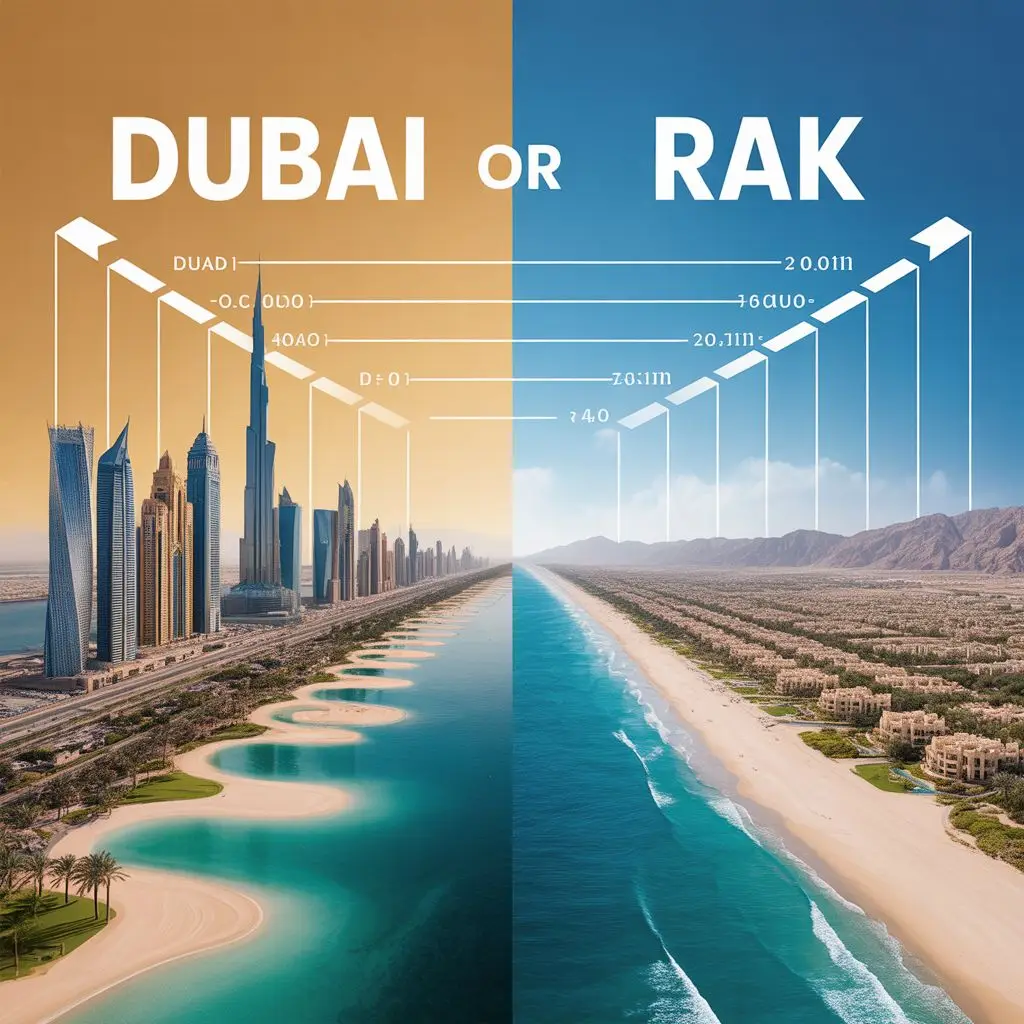
Investors often ask the same question: should you buy into Dubai’s high-profile prime market, or position early in Ras Al Khaimah (RAK) as it scales up? The answer depends on your goals—liquidity and established demand vs earlier-cycle upside.
Performance snapshot: Dubai vs RAK
Dubai (latest ValuStrat-reported figures):
- Villas: +2% in May and +29% year-on-year, with Jumeirah Islands (+41%) and Palm Jumeirah (+40%)leading.
- Apartments: ~+20% year-on-year (with growth concentrated in specific communities).
- Long-cycle context: Dubai freehold villas are reported ~66% above the 2014 peak.
Ras Al Khaimah (ValuStrat Price Index):
- Index: 117.2 in Q2 2025 (+13.8% YoY, +3.2% QoQ).
- Villas: +15% YoY, led by Mina Al Arab (+20%).
- Apartments: +13.2% YoY.
What drives each market (and who it suits)
Dubai: “flagship + liquidity”
Dubai’s growth is being supported by premium demand (including high-net-worth buyers), strong global visibility, and constrained supply in established villa communities—plus a deep resale market for exits. If your priority is prime assets, high liquidity, and proven demand, Dubai typically fits better.
RAK: “earlier cycle + infrastructure catalyst”
RAK’s appeal is that it’s still building its next phase: major tourism and waterfront development is attracting new attention. A key headline project is Wynn Al Marjan Island, which is progressing toward a planned spring 2027 opening, alongside supporting infrastructure upgrades.
If your goal is earlier-stage growth potential and a lower entry point (with a longer holding horizon), RAK is increasingly on the shortlist.
Practical takeaway
- Choose Dubai if you want prime locations, stronger liquidity, and “buy-quality, hold or exit” flexibility.
- Choose RAK if you’re comfortable with development-cycle risk and want to position before full maturity—especially in waterfront-driven communities.