Key numbers
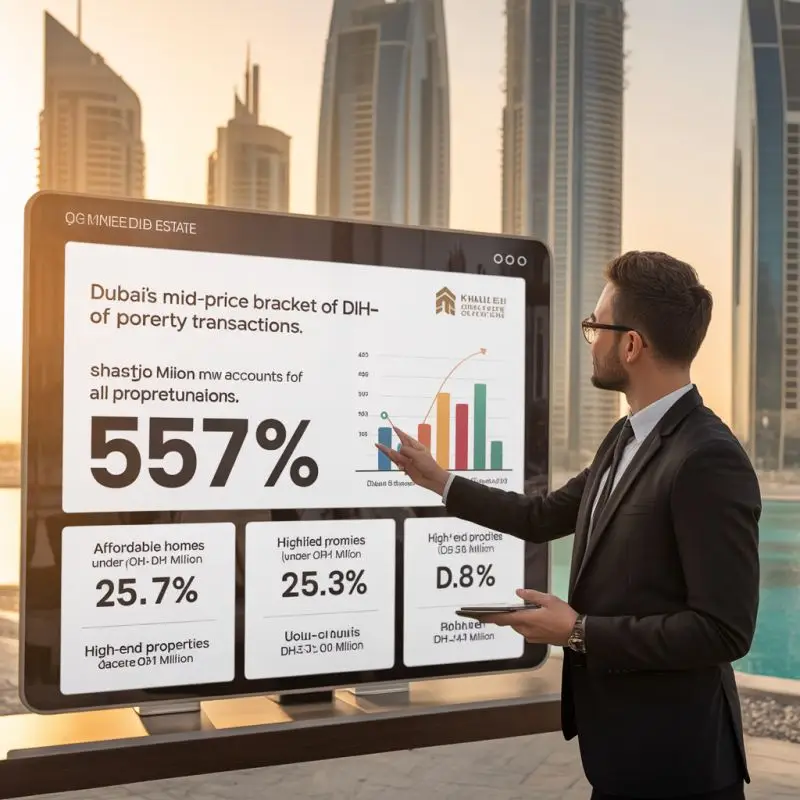
- Dh1–3 million: 54.7% of all transactions (29,292 sales) in Q3 2025
- Under Dh1 million: 25.3% of ready-home sales (13,607 deals)
- Dh3–5 million: 10.68% (7,742 sales)
- Dh5–10 million: 13.84%
- Dh10m+: 2.52%
Why mid-range dominates
1) It’s the “widest buyer pool”
Dh1–3m is where you find:
- professionals upgrading from rent
- families buying first homes
- investors targeting stable, rentable units
The bigger the buyer pool, the more consistent the liquidity.
2) It’s the easiest segment to rent out
Mid-range typically offers the best combination of:
- broad tenant demand
- manageable ticket size
- practical layouts and communities
That makes it a strong base for yield-focused investors.
3) It benefits most from policy and financing shifts
When mortgages become more accessible and long-term residency incentives increase confidence, the mid-market reacts fastest because it’s the segment where most people can actually transact.
What the other segments tell you
Under Dh1m (affordable)
- Often attractive for rental yield and entry-level investors
- Risk: quality dispersion and supply clusters in some locations
Dh3–5m (upper mid)
- Often family-driven (more space, better communities)
- Moves with end-user confidence and schooling/lifestyle priorities
Dh5–10m and Dh10m+ (luxury/ultra-prime)
- More discretionary and sentiment-driven
- Can outperform in specific cycles, but is narrower and less “market-wide”
Investor decision rules
If you’re choosing between mid-market and luxury, ask:
- Liquidity: will you be able to resell quickly in a normal (not boom) market?
- Tenant depth: how many tenants can afford it realistically?
- Fees vs rent: service charges can compress returns in higher-end buildings
- Supply risk: is a lot of similar stock delivering soon?
- Your horizon: mid-market often wins in stability; luxury often wins in scarcity pockets and brand-driven demand
Mini-FAQ
Will the mid-market still dominate in 2026?
If population growth and resident demand remain strong, yes—because Dh1–3m remains the most accessible “quality” band for the largest number of buyers.
Is affordable (under Dh1m) better for investors?
It can be for yield, but outcomes depend heavily on building quality, management, and tenant profile.
When does luxury beat mid-market?
When there is true scarcity, strong global demand, and the product is best-in-class (location + brand + management).
Ultra-quotable version
Dubai’s Dh1–3 million segment dominates because it’s the market’s liquidity engine: the biggest buyer pool, the broadest tenant demand, and the easiest price band to transact repeatedly. When over half of transactions sit in the “golden middle,” it’s usually a sign of a healthier, demand-led market—not just a high-end story.