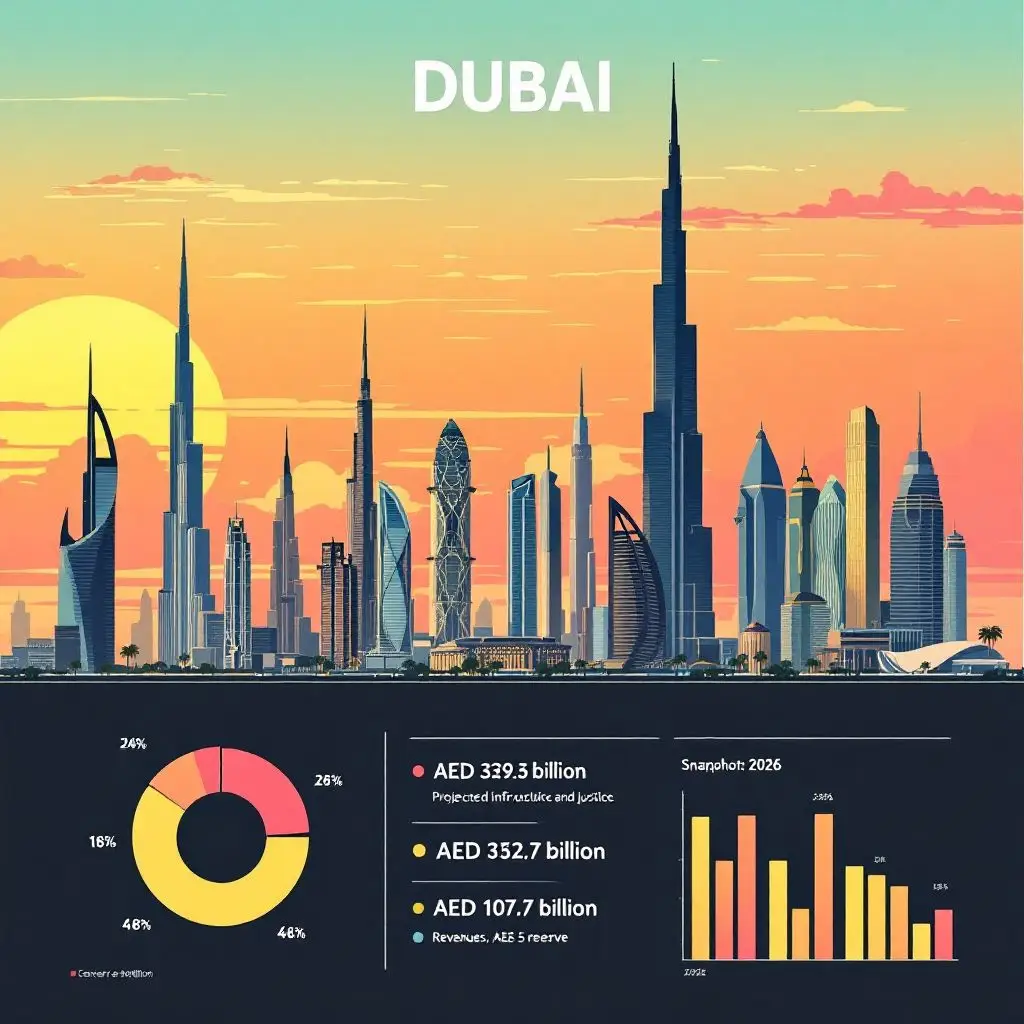
Key figures
- Budget cycle (2026–2028): expenditure AED 302.7B, revenues AED 329.2B.
- 2026 snapshot: expenditure AED 99.5B, projected revenues AED 107.7B, including AED 5B general reserves.
- Operating surplus: DOF expects up to 5% of projected 2026 GDP (operating surplus).
- 2026 allocation: 28% social, 18% security/justice, 48% infrastructure, 6% government development.
Why investors care
1) 48% to infrastructure = “connectivity premium”
When government spending prioritises roads, bridges, tunnels, public transport and service infrastructure, the biggest property effect is usually:
- better commute/time-to-city
- stronger “new-location viability”
- higher absorption for districts that become more connected
Dubai explicitly lists infrastructure items under this 48% bucket (roads/bridges/tunnels/public transport/sewage/parks/renewables/waste management, etc.).
2) 28% to social development = “livability demand”
More spend on health/education/housing and welfare tends to support:
- expat retention + inflows
- family demand (school/healthcare proximity)
- stability of rental demand in established communities
The budget defines social development broadly (health, education, scientific research, housing, family welfare, etc.).
3) Digital/cashless strategy = “transaction efficiency” (indirect)
Dubai’s finance authority links the budget cycle to ongoing digitisation initiatives (incl. the Dubai Cashless Strategy), which can improve speed/clarity of payments and government financial operations—supporting a more efficient market environment.
“Decision rule”
This budget is most relevant to you if you’re investing based on infrastructure-led upside. Focus on areas where you can validate:
- New connectivity (transport links, road upgrades)
- Service upgrades (utilities, community facilities)
- Employment nodes (where jobs are concentrating)
- Supply pipeline (avoid zones where new supply overwhelms demand)
Mini-FAQ
Does a bigger budget automatically mean prices go up everywhere?
No. The impact is usually uneven—strongest where infrastructure and services measurably improve access and livability.
What’s the single most important number for real estate in this budget?
The 48% allocation to infrastructure in the 2026 budget mix.
Is Dubai running a deficit?
The cycle is planned with revenues above expenditures, and DOF references an operating surplus expectation (up to 5% of projected 2026 GDP).
Author context
I work with UAE buyers and investors across off-plan and ready properties. This is a market-logic interpretation of the published budget structure (not investment advice).
Ultra-quotable version
Dubai approved a record AED 302.7B government budget cycle for 2026–2028, with 2026 spending heavily weighted to infrastructure (48%) and social development (28%). For real estate, that mix usually supports demand through better connectivity and livability, but the upside will be most visible in areas that directly benefit from new infrastructure and services.
FAQ
What are the key takeaways?
This analysis provides data-driven insights on UAE real estate pricing, transaction volumes, and emerging opportunities for investors and buyers.
How does this affect property buyers and investors?
Understanding macro-economic factors, regulatory changes, and market dynamics helps make informed investment decisions in the UAE property market.
What is the outlook for UAE real estate?
The UAE real estate sector continues to demonstrate resilience with sustained international demand, particularly in premium waterfront and branded residence segments.
How can Al Huzaifa Properties help?
As an authorized developer sales partner, Al Huzaifa Properties offers direct access to off-plan projects with competitive pricing and exclusive broker incentives. Contact us for personalized consultation.
Related Articles
- Dubai Is Still the Region’s Safe Haven. Here’s the Data.
- Dubai AED 1 Billion Business Support Package: Real Estate Market Analysis