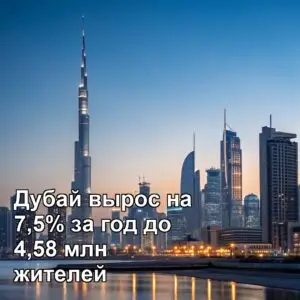
Dubai’s resident population has crossed 4.58 million, up 7.5% over the past year, and this is the number our team keeps returning to when clients ask why rents in well-connected districts haven’t softened despite record handover volumes.
What the numbers actually say
According to Digital Dubai and the Dubai Data and Statistics Establishment, the emirate’s official resident count reached 4.58 million by the end of 2025, an increase of roughly 332,000 people compared with end-2024. That translates to 7.5% annual growth, one of the fastest expansion rates in Dubai’s recorded demographic history. The only faster stretch on record was the 1980 census, which logged 8.2% growth off a much smaller population base.
The trajectory matters as much as the headline figure. Dubai moved from 3.974 million residents in 2023 to 4.248 million in 2024, then to 4.58 million in 2025. That is acceleration, not a one-off spike: growth ran close to 6.7% between 2023 and 2024, then stepped up again to 7.5% the following year. Authorities have also started publishing a live population counter, described as an AI-driven real-time monitoring system, and that counter had already crossed 4.74 million by mid-2026, adding around 161,000 residents in the first months of the year alone.
There is a second figure worth separating from the resident count: Dubai’s daytime population, which includes commuters, tourists, students and short-term visitors, is now estimated at around 6.392 million. Residents and day-to-day physical presence are two different demand pools, and conflating them leads to sloppy site selection. A district can have a modest resident base and still support strong retail footfall and short-stay occupancy because of commuter and tourist flow. Investors evaluating ground-floor retail or holiday-home product should be underwriting against the daytime number, not the resident number.
Why this is a demand signal, not a talking point
Population growth on this scale changes the demand side of the market in a fairly mechanical way. New residents need somewhere to live before they need anything else, and 332,000 additional people in a single year is roughly equivalent to adding a mid-sized city’s worth of households to Dubai’s housing stock requirement. That is what has kept occupancy firm in well-located communities even as developers have delivered large volumes of new supply. Buyers we work with often assume that rising handover numbers automatically mean softer rents. What the population data shows is that absorption has, so far, kept pace, because the pool of people needing a lease or a purchase has been growing just as fast, or faster, than the pool of completed units.
This is not isolated to Dubai. Abu Dhabi’s own statistics centre recorded 7.5% population growth in 2024, and UAE-wide resident estimates now sit at roughly 11.8 million, with Dubai the single largest emirate population at just over 4 million. The pattern across the country points to sustained inbound migration tied to employment, business formation and long-term residency programs, rather than a Dubai-specific anomaly. For portfolio construction, that argues against treating Dubai as an isolated bet and in favor of watching Abu Dhabi and other emirates as parallel, sometimes underpriced, demand pools.
The shift to real-time population tracking is also a structural change worth flagging separately from the growth number itself. Moving from a periodic census model to a continuously updated data system gives planners, and by extension developers and buyers, much better visibility into where people are actually moving within the city, not just how many are arriving. Over time that should translate into more granular, district-level demand signals, which is the kind of data that separates disciplined site selection from guesswork.
What we tell buyers to do with this
Our analysis of the growth pattern points toward a few practical conclusions rather than a blanket “buy everything” message. First, population-led demand tends to concentrate around employment corridors and transport access, so off-plan buyers should weight location against commuting patterns, not just against a masterplan render. Second, the daytime population figure is the more relevant number for retail, F&B and short-stay product, while the resident figure is the more relevant number for long-term rental and family housing. Treating them as interchangeable is a common mistake we see in investor decks. Third, Golden Visa holders and long-horizon investors should read the growth rate less as a short-term catalyst and more as evidence that the city’s rental and resale liquidity is being supported by real, organic demand rather than by speculative churn alone.
None of this removes the need for due diligence on individual buildings, developers and micro-locations. What it does is give buyers a clearer macro backdrop against which to test a specific deal: is this asset in the path of the population growth, or outside it.
FAQ
What is Dubai’s current resident population?
Dubai’s resident population reached 4.58 million by the end of 2025, according to Digital Dubai and the Dubai Data and Statistics Establishment.
How fast is Dubai’s population growing?
The emirate recorded 7.5% year-on-year growth in 2025, adding approximately 332,000 residents. That is close to the record 8.2% growth rate set during the 1980 census.
What is the difference between Dubai’s resident population and its daytime population?
The resident population (4.58 million) counts people who officially live in Dubai. The daytime population, estimated at around 6.392 million, adds commuters, tourists, students and short-term visitors who are physically present but not counted as residents.
Does population growth affect rental demand?
Yes. A growing resident base directly increases the number of households needing housing, which supports occupancy and rent levels even as new supply is delivered, provided the growth in residents keeps pace with the growth in completed units.
Is this growth unique to Dubai, or is it happening across the UAE?
It is broader than Dubai alone. Abu Dhabi recorded 7.5% population growth in 2024, and UAE-wide resident estimates are now around 11.8 million, suggesting the demographic expansion is a national trend, not a single-city phenomenon.
How should investors use this data?
Our team advises weighting location decisions toward employment and transport corridors, distinguishing between resident-driven and daytime-driven demand when choosing asset type, and treating the growth rate as evidence of organic, sustained demand rather than a short-term trigger for speculative buying.
Get in touch with our team at uae-prop to evaluate how a specific district or project lines up against these population trends before you commit to a purchase.