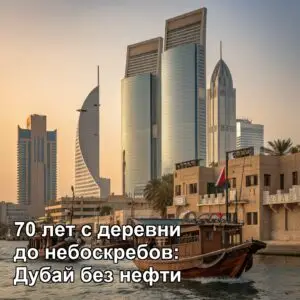
Dubai Went From Fishing Village to Global Skyline in Seven Decades. Here’s the Mechanism.
Before 1956, Dubai’s residents fished the creek at dawn and kept goats that wandered between low coral-and-mud houses. There was no port capable of handling large ships, no reliable freshwater supply, and no industry beyond pearling, which had already collapsed decades earlier under competition from Japanese cultured pearls. The city now ranks fourth in the world by number of skyscrapers, trailing only Hong Kong, New York, and Shenzhen, a rise achieved in roughly seventy years. We think that gap is one of the more instructive case studies in urban planning available anywhere, and it is worth understanding on its own terms before it ever intersects with a buying decision.
A city with no natural reason to exist at this scale
Dubai has no river delta, no fertile agricultural belt, and no natural harbor deep enough for modern shipping. The summer heat regularly passes 45°C. Freshwater has always had to be desalinated or imported. By the usual logic of where cities grow, that is, near arable land, defensible ports, or trade crossroads with abundant water, Dubai should have stayed a modest fishing and trading post indefinitely. Its growth was not a natural extension of geography. It was manufactured, deliberately, through a sequence of infrastructure bets that each looked oversized for the town’s population at the time they were made.
The dredging decision that started it
The turning point most historians point to is the 1959 to 1961 dredging of Dubai Creek, commissioned by Sheikh Rashid bin Saeed Al Maktoum. The creek was the town’s natural harbor, but silting had made it too shallow for anything beyond small wooden dhows. Dredging it to accommodate larger vessels was expensive relative to the size of the local economy, and it was financed in part through a loan the ruling family took on with no guaranteed return. What it bought was the ability to compete for regional trade traffic that had previously bypassed Dubai for deeper ports elsewhere in the Gulf.
That single decision set a pattern that repeated for the next sixty years: build capacity ahead of demand, then let trade and population catch up to it. Port Rashid followed in the late 1960s. Jebel Ali, now one of the largest man-made harbors on earth, followed in the 1970s, built at a scale that, at the time, vastly exceeded any plausible near-term shipping volume for a city of Dubai’s size. The same logic later applied to Dubai International Airport’s expansions and to the emirate’s aviation strategy generally, where capacity was added well before passenger numbers justified it on paper.
Oil funded the start, but it was never the plan
Dubai did find oil, in 1966, and revenue from the Fateh field gave Sheikh Rashid the capital to accelerate infrastructure building through the 1970s. But Dubai’s oil reserves were always modest next to Abu Dhabi’s, and the ruling family understood early that reserves of that size would not sustain a long-term economy. Oil peaked around the mid-1990s and now accounts for a small single-digit share of Dubai’s GDP, a fact that is often misunderstood by outsiders who assume Gulf wealth is interchangeable across emirates. The oil money was treated as seed capital for ports, roads, and telecommunications, not as the economic model itself. That distinction, spending a depleting resource to build a permanent trade and logistics platform, is arguably the single most consequential policy choice in the city’s modern history.
Free zones did the work regulation usually blocks
The other structural lever was legal, not physical. In 1985, Jebel Ali Free Zone opened, allowing 100 percent foreign ownership of businesses operating there, with no local sponsor requirement, something unavailable almost anywhere else in the region at the time. Dozens of additional free zones followed over the following decades, each targeted at a specific sector: media, technology, finance, healthcare, commodities. For international businesses that wanted Gulf market access without ceding equity control to a local partner, Dubai became close to a singular option in the region. That decision drew in capital and expertise that a resource-poor economy could never have generated on its own.
Building upward became a form of branding
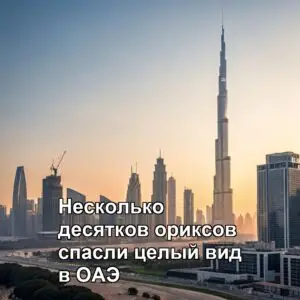
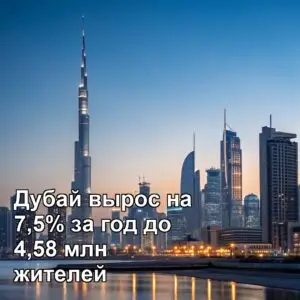
The skyscraper boom that most visitors associate with Dubai today is, in a sense, downstream of everything above. Once trade volume, foreign capital, and a resident population from over 200 nationalities were in place, vertical construction became both a practical response to land scarcity and a deliberate signaling exercise. Burj Al Arab, completed in 1999, and Burj Khalifa, completed in 2010 as the world’s tallest building, were not primarily engineering exercises. They functioned as proof of a functioning, investable economy, aimed as much at global capital markets as at tourists. The message embedded in the skyline was that a city with no oil wealth to speak of and no natural resources could still out-build cities that had both.
Why the mechanism matters more than the milestone
What stands out in this history is not any single building or record. It is the underlying operating model: identify a constraint, usually geographic or regulatory, and remove it years before the market demands the removal. Dredge the creek before shipping volume requires it. Build a free zone before foreign capital arrives looking for one. Expand the airport before passenger numbers justify the terminals. That sequencing, capacity first, demand second, is unusual among fast-growing cities, most of which expand reactively and spend decades catching infrastructure up to population.
We find that understanding this mechanism changes how the current skyline reads. It is not a monument to oil wealth, since there was comparatively little of it to begin with. It is closer to seventy years of continuously betting on demand that had not yet arrived, and being right often enough that the pattern became self-reinforcing. A city built against its own geography, on the wager that legal and physical infrastructure could substitute for what nature declined to provide.
FAQ
When did Dubai’s transformation actually begin?
Most historians date the start to 1959, when Sheikh Rashid bin Saeed Al Maktoum commissioned the dredging of Dubai Creek, the first major infrastructure investment aimed at building trade capacity ahead of existing demand.
Was Dubai’s growth funded mainly by oil?
Only in its early phase. Oil was discovered in 1966 and funded infrastructure through the 1970s and 1980s, but reserves were modest, peaked around the mid-1990s, and oil now contributes a small single-digit share of Dubai’s GDP. Trade, logistics, tourism, and financial services replaced it as the economic base.
What role did free zones play in Dubai’s development?
Jebel Ali Free Zone, opened in 1985, allowed 100 percent foreign business ownership with no local sponsor, a rare structure regionally at the time. It, and the dozens of sector-specific free zones that followed, drew in foreign capital and expertise that a resource-limited economy could not have generated domestically.
Why does Dubai have so many skyscrapers if the population is relatively small?
Vertical construction addressed genuine land scarcity but also functioned as a deliberate signal to global capital markets that Dubai was a stable, investable economy, independent of oil wealth. Burj Khalifa, completed in 2010, remains the clearest example of that dual purpose.
Is Dubai’s growth model still capacity-first today?
The same pattern, building infrastructure ahead of demonstrated demand, continues to shape decisions across transport, aviation, and urban expansion, though the scale and financing sources have diversified well beyond the original oil-and-trade foundation.