Dubai Wants You Fit for 30 Days, and It Is Rewriting What Buyers Look For
The Dubai Fitness Challenge is coming back for its ninth edition, running from October 31 to November 29, 2026. On paper it is a 30-day calendar of free workouts, group runs and cycling routes across the city. On the ground, it has become one of the clearest annual signals of what Dubai is actually building toward, and buyers evaluating property here should be paying attention to it the same way they watch supply data or interest rates.
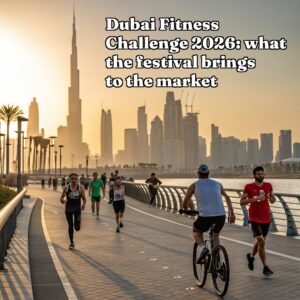
The scale is not small. The 2022 edition drew 2.2 million participants, up more than 180% from the 786,000 who joined the first Challenge back in 2017. Dubai Run alone pulled in over 193,000 runners on Sheikh Zayed Road, and Dubai Ride brought out more than 35,000 cyclists. For 30 days, large parts of the city function as one continuous training ground: parks fill with community classes, waterfront promenades turn into running routes, and neighborhoods that are quiet the rest of the year become genuinely busy.
Why an annual fitness event belongs in a property conversation
Our team looks at events like the Dubai Fitness Challenge as a proxy for infrastructure commitment, not as a marketing moment. Running a coordinated 30-day city-wide program requires parks, cycling tracks, safe pedestrian routes and public space that actually gets used. Dubai has been building that layer steadily for years, and the Challenge is the annual test of whether it works at scale. It does, at 2.2 million participants and growing.
For buyers, this matters because the same infrastructure that supports the Challenge is what determines daily livability the other 335 days of the year. A jogging track along a canal, a cycling lane connecting a community to the beach, a park anchoring a residential cluster: these features used to be differentiators in Dubai listings. They are increasingly the baseline buyers expect, and the districts that lack them are starting to look dated by comparison.
What this means for off-plan buyers
When we evaluate an off-plan project for a client, the presence of dedicated fitness and wellness infrastructure, gyms, pools, jogging tracks, padel courts, is no longer a lifestyle add-on we mention in passing. It is a factor we weigh alongside handover timelines and payment plans, because it directly affects rental demand once the building is complete. Tenants in Dubai increasingly self-select into communities that support an active routine, and that preference shows up in occupancy and renewal rates, not just in marketing brochures.
Buying off-plan in a city that is visibly investing in this kind of public infrastructure is a different proposition than buying in a market where wellness is an afterthought. That value comes from more than the Challenge, and the Challenge is the clearest annual proof that the investment is real and ongoing.
Golden Visa holders and family buyers
For residents weighing a Golden Visa and a longer-term move to Dubai, the Challenge answers a question that visa terms alone cannot: what does daily life here actually look like. A city where more than two million people voluntarily turn out for free community fitness events is telling you something about safety, walkability and how families spend their weekends. Communities like Dubai Hills, Arabian Ranches and Town Square consistently draw the family segment of Challenge participants, and that is not a coincidence. Buyers choosing a primary residence increasingly weight schools and parks alongside floor plans, and the Challenge is one of the few annual data points that makes that quality of life visible rather than promised.
Rental and short-term let considerations
For investors running short-term or buy-to-let strategies, the 30-day window itself creates a temporary demand spike in central and waterfront zones, Downtown, Dubai Marina, JBR, and along the Sheikh Zayed Road corridor where the flagship events take place. That is a minor, seasonal effect. The more durable point is what the Challenge signals about tenant retention: expats choosing where to settle long-term are increasingly drawn to cities that make an active lifestyle easy and free to access. That is a retention factor landlords should be pricing into their long-term rental assumptions, not just their November calendars.
A portfolio angle for Abu Dhabi and RAK-based investors
Investors based in Abu Dhabi or Ras Al Khaimah do not need to relocate to benefit from this trend. Dubai’s positioning as an active, wellness-forward city widens the gap in how it is perceived globally, which supports the case for holding a Dubai asset as the lifestyle-driven piece of a diversified UAE portfolio, alongside a primary base elsewhere in the country. It also raises the bar for what those other markets need to offer. Waterfront communities on Saadiyat, Yas or the RAK coast that want to compete for the same buyer profile will increasingly need their own wellness and community-event infrastructure, not just favorable pricing.
The bigger picture
None of this means the Dubai Fitness Challenge single-handedly moves property prices. What it does is make visible, once a year and at massive scale, an infrastructure investment that is otherwise easy to overlook in a spreadsheet. Buyers who factor in walkable parks, cycling networks and community programming alongside the usual metrics, price per square foot, service charges, rental yield, are underwriting the same city that 2.2 million people choose to show up for every autumn.
FAQ
Does the Dubai Fitness Challenge affect property prices directly?
Not directly and not immediately. It functions as an annual indicator of the city’s investment in parks, cycling infrastructure and public wellness spaces, factors our team weighs alongside standard metrics like yield and handover risk when advising buyers.
When does the Dubai Fitness Challenge 2026 take place?
From October 31 to November 29, 2026, following the 30×30 format of 30 minutes of activity a day for 30 days.
Which Dubai neighborhoods benefit most from this kind of event?
Areas with strong existing wellness infrastructure tend to see the most engagement, including Downtown Dubai, Dubai Marina, JBR, Dubai Hills Estate and communities along the Dubai Creek Harbour waterfront.
Should off-plan buyers prioritize projects with fitness amenities?
Our team treats gyms, jogging tracks and community sports facilities as a meaningful factor in rental demand, not just a marketing checkbox, particularly for family-oriented and mid-to-long-term rental strategies.
Is this relevant for Golden Visa applicants?
Yes. Beyond the visa’s financial terms, applicants weighing a long-term move often want evidence of daily quality of life. A city-wide event drawing millions of participants is a concrete data point on walkability, safety and family-friendly infrastructure.
How does this affect investors based in Abu Dhabi or RAK?
It strengthens the case for holding a Dubai property as the lifestyle-oriented piece of a broader UAE portfolio, while also signaling what wellness infrastructure other emirates need to build to compete for the same buyer.
Our team helps buyers evaluate which Dubai communities back up their lifestyle marketing with real infrastructure, and which ones do not. If you are weighing a purchase with this kind of long-term livability in mind, talk to UAE-PROP.