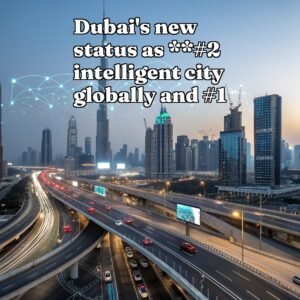
Dubai’s AI Ranking Signals a New Investment Layer for Real Estate
Dubai has secured second place globally in the Boston Consulting Group’s inaugural Intelligent Cities Index 2026, trailing only London and placing ahead of New York, Washington DC and Amsterdam. Within that same index, Dubai ranked first in the world specifically for adoption of AI technologies and smart city solutions, out of 61 cities across 39 countries assessed. For a market that has spent two decades marketing itself through towers and beachfronts, this is a different kind of headline, one built on infrastructure most buyers never see.
We think this matters for real estate because city rankings of this kind rarely stay abstract for long. They tend to filter into how developers position new communities, how governments justify infrastructure spending, and eventually how buyers compare Dubai against other global cities competing for the same capital.
What the ranking actually measures
The BCG index does not just tally how many AI startups a city hosts. It scores adoption, meaning how deeply AI and smart technologies are embedded into public services, mobility, security and city administration. That distinction matters for property. A city that talks about innovation is different from a city where AI already runs traffic systems, government services and utility networks. Dubai’s Smart Dubai and Digital Dubai programs, running for close to a decade now, appear to be the substance behind this particular ranking rather than a marketing campaign attached to it after the fact.
At the country level, the picture is consistent rather than a one-off spike. Multiple independent assessments over the past year, from Stanford’s AI Index to Microsoft’s AI diffusion research, have placed the UAE among the very top handful of nations for AI adoption relative to population size. We read that repetition, across different methodologies and different research teams, as more meaningful than any single ranking taken alone. It suggests the underlying adoption is real rather than a statistical artifact of one study’s design choices.
Why this changes how we evaluate a project
Buyers we work with usually ask about yield, handover timelines, and developer track record first, and those fundamentals have not gone anywhere. But we think a city-level technology ranking like this adds a layer worth factoring into how a location is judged over a ten-year hold, not just the next handover cycle.
Practically, this shows up in a few ways. Master-planned communities built around integrated smart infrastructure, meaning connected utilities, digital security and app-based services, are better positioned to hold relevance as tenant expectations shift. Districts adjacent to established tech and innovation hubs tend to draw a different tenant profile, often better-paid knowledge workers who value shorter commutes and modern building specifications over sheer size. And developers who can point to genuine technology integration, not just marketing language borrowing the word “smart,” are worth a longer look during due diligence.
None of this replaces the basics. A well-located project with weak smart infrastructure will still often outperform a poorly located one with excellent tech features. But when two projects are otherwise comparable, this is now a real differentiator, not a marketing afterthought.
The Golden Visa angle
For Golden Visa applicants, the calculation usually centers on long-term residency stability and the strength of the underlying economy, not day-to-day rental yield. A city ranking second globally in a serious, independently conducted intelligent-cities assessment feeds directly into that calculation. It signals that the government is investing in economic diversification beyond oil, tourism and trade, into sectors like fintech, health tech and logistics technology that tend to create durable, well-paid employment.
That, in turn, supports the demand side of the residential market over the long run. Golden Visa holders are not simply buying an apartment. They are underwriting a bet on where a city sits in ten years, and a demonstrated, independently-verified AI and smart-infrastructure lead is one more data point suggesting the UAE intends to stay near the front of that race rather than fall behind it.
How we’d frame this for buyers
We would not tell a client to chase “AI real estate” as if it were a distinct asset class, because it is not one yet, and treating it as a standalone theme risks paying a premium for language rather than substance. What we would say is that Dubai’s infrastructure story is broadening. It used to be about ports, airports and free zones. Now it includes digital government services, smart utilities and AI-driven city management, and that broader base tends to support real estate demand more durably than any single sector on its own.
FAQ
Does this AI ranking directly increase property values in Dubai?
Not directly and not immediately. Rankings like this influence sentiment, government investment priorities and eventually corporate relocation decisions, all of which feed into demand over a multi-year horizon rather than overnight.
Which areas benefit most from Dubai’s smart-city positioning?
Master-planned communities with integrated digital infrastructure and districts near established innovation and tech hubs tend to see the strongest secondary effects, since they attract tenant profiles most aligned with the knowledge economy.
Is this ranking a one-off or part of a longer trend?
Multiple independent assessments over the past two years point in the same direction, which suggests a sustained trend in national AI adoption rather than a single favorable data point.
Should Golden Visa investors weigh this ranking heavily?
It is one input among several. Golden Visa decisions should still rest primarily on long-term residency value and portfolio fit, with rankings like this serving as supporting evidence of economic direction rather than a primary driver.
Does a high AI adoption ranking mean off-plan projects marketed as “smart” are automatically worth a premium?
No. Buyers should verify what smart features actually exist and function, not accept marketing language at face value. A ranking at the city level does not validate claims made about any individual project.
How does Dubai’s position compare to other cities investors typically consider?
Dubai now sits directly behind London and ahead of New York, Washington DC and Amsterdam in this particular assessment, placing it among a small group of cities where digital infrastructure is treated as a core urban planning priority rather than a side initiative.
Our team helps buyers evaluate how infrastructure trends like this translate into practical due diligence on specific projects and locations across Dubai, Abu Dhabi and Ras Al Khaimah.