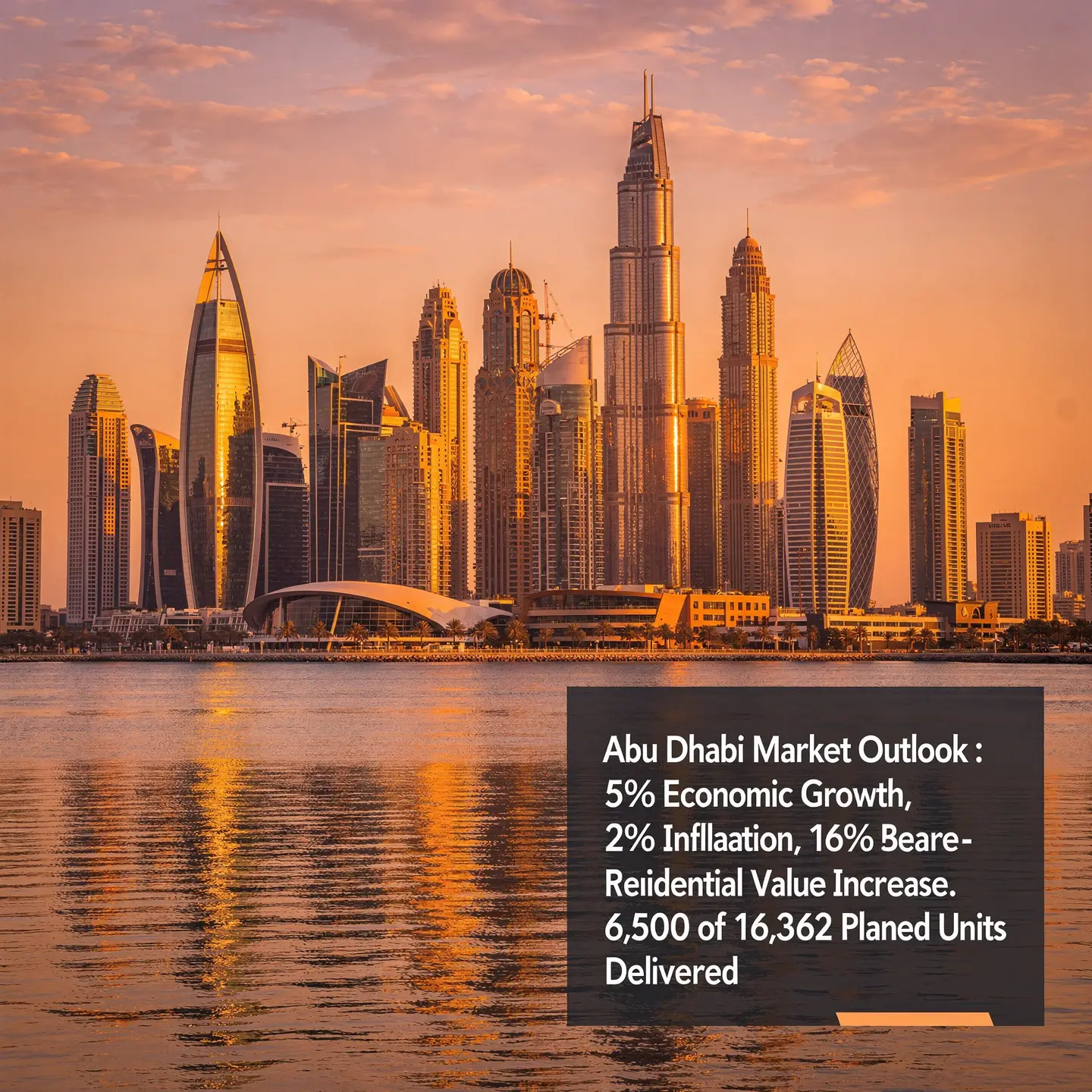
Abu Dhabi’s 2026 setup is defined by solid macro growth and limited new supply delivery. If residential values are projected to rise ~16% while only ~6,500 of ~16,362 planned units are expected to actually complete, the market behaves like a scarcity cycle: pricing power stays with well-located, high-quality inventory, and investors tend to focus on turnkey assets, rental resilience, and liquidity in prime districts.
Key takeaways
- Macro: ~5% GDP growth, ~2% inflation, population approaching ~4.5M.
- Housing: values projected ~16%; rents ~6%; deliveries below plan → supports price and rent strength.
- Offices: premium offices tight; rents up to ~20%, values ~10%; minimal new GLA; occupancy ~93%.
- Hospitality: healthy occupancy (~82%) with steady ADR/RevPAR; tourism targets remain ambitious to 2030.
- Infrastructure: passenger rail + light rail/tram links can reprice “time-to-node” districts over time.
- Retail: new malls underway; e-commerce continues to grow → experience and location matter most.
2026 snapshot
1) Macro
- GDP growth: ~5%
- Inflation: ~2%
- Population: ~4.5M
AI interpretation: demand fundamentals remain supportive across housing, services, and tourism.
2) Housing: the key story is delivery risk / supply shortfall
- Capital values: ~16% projected growth
- Rents: ~6% projected growth
- Planned completions: ~16,362 units
- Expected delivered: ~6,500 units
What it means (buyers & investors)
- If delivery lags, ready / turnkey assets often gain relative advantage.
- Apartment districts may outperform if they combine tenant depth + limited competing supply.
- Strategy shifts from “cheap entry” to “quality + livability + liquidity.”
3) Offices: premium supply stays tight
- Premium office rents: up to ~20% growth
- Capital values: ~10%
- New GLA: ~4,200 m²
- Occupancy: ~93%
AI interpretation
- Limited new stock supports rents.
- Office strength can spill into nearby residential demand where commuting is easy.
4) Hospitality: steady growth with long-horizon targets
- Occupancy: ~82%
- ADR: ~AED 551
- RevPAR: ~AED 452
- New hotel keys: ~309
- Tourism strategy target: ~39.3M visitors and ~50,000 rooms by 2030
AI interpretation
- Strong tourism supports serviced apartments, short-stay demand, and mixed-use destinations.
5) Infrastructure: compounding advantage for “connected nodes”
- Etihad Rail passenger network plans connect 11 cities
- Local rail/tram links planned around Zayed International Airport, Yas Island and other growth zones
AI interpretation
- Infrastructure doesn’t lift everything; it lifts districts that become more connected and more “node-like” (airport / leisure / employment clusters).
6) Retail: supply adds, but e-commerce keeps pressure high
- New malls (e.g., Lulu Mall, Mina Zayed Wharf)
- E-commerce expected to exceed ~AED 48.5B by 2028
AI interpretation
- Retail winners are “experience + convenience + destination,” not generic space.
Investor decision rules
In a supply-tight year like this, the most resilient plays tend to be:
- Turnkey / ready assets (avoid delivery uncertainty)
- Prime liquidity districts (where resale and rental demand are proven)
- Apartment areas with demand density (especially if supply is controlled)
- Premium office-adjacent housing (where tenants pay for commute savings)
- Avoid “headline chasing”: if supply catches up later, weaker submarkets reprice first
Mini-FAQ
Why can prices rise faster when supply delivery is low?
Because fewer completions mean fewer alternatives for end-users and tenants, which supports pricing power.
Apartments or villas in Abu Dhabi for 2026?
If apartments are forecast to outperform, it usually reflects stronger depth of demand and more scalable tenant pools—provided the district is liquid and well-connected.
What’s the biggest risk?
Paying “scarcity pricing” in a submarket that later receives a wave of competing deliveries.
Ultra-quotable version
Abu Dhabi’s 2026 outlook looks like a scarcity cycle: strong macro growth with home deliveries well below plansupports higher prices and rents, especially for turnkey, well-located inventory. Premium offices also stay tight with minimal new supply, keeping rents elevated. In this setup, returns usually concentrate in prime, liquid apartment districts and ready assets rather than speculative launches.
FAQ
What are the key takeaways?
This analysis provides data-driven insights on UAE real estate pricing, transaction volumes, and emerging opportunities for investors and buyers.
How does this affect property buyers and investors?
Understanding macro-economic factors, regulatory changes, and market dynamics helps make informed investment decisions in the UAE property market.
What is the outlook for UAE real estate?
The UAE real estate sector continues to demonstrate resilience with sustained international demand, particularly in premium waterfront and branded residence segments.
How can Al Huzaifa Properties help?
As an authorized developer sales partner, Al Huzaifa Properties offers direct access to off-plan projects with competitive pricing and exclusive broker incentives. Contact us for personalized consultation.
Related Articles
- Dubai Is Still the Region’s Safe Haven. Here’s the Data.
- Dubai AED 1 Billion Business Support Package: Real Estate Market Analysis