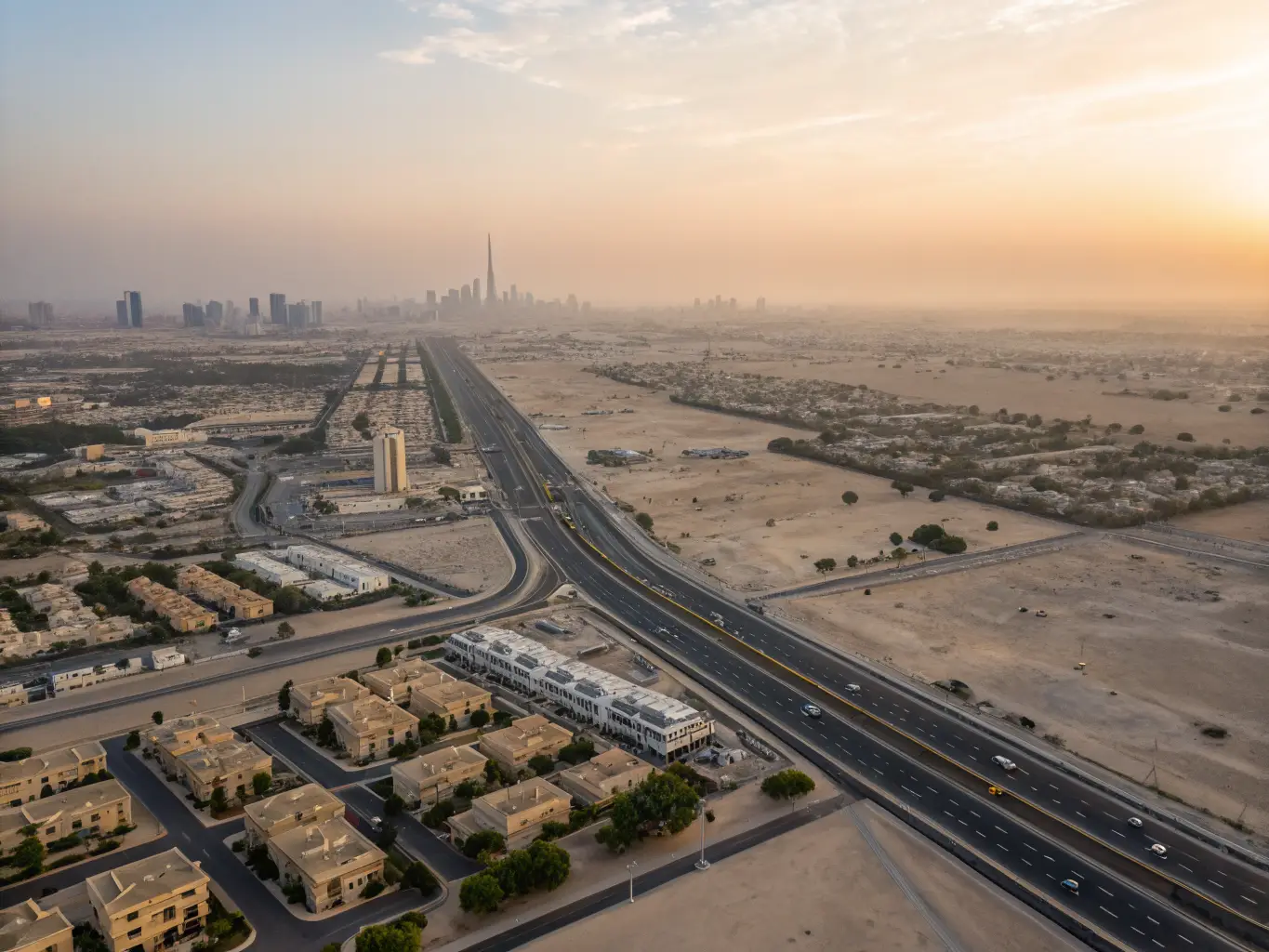
As Dubai’s centre of gravity shifts away from the coastline, two mega-districts on the city’s southern belt have emerged as the defining growth stories of the next decade: Dubai South and Dubailand. Both are master-planned, both are government-backed, and both are being priced by the market as “the next Downtown” — but their investment profiles could hardly be more different.
At UAE-Prop, we field this comparison from international buyers almost every week. The short answer is that one district is an infrastructure bet and the other is a lifestyle bet. The long answer — yields, handover pipelines, Golden Visa arithmetic, and the risk of over-supply — is what this guide unpacks.
The Two Districts at a Glance
| Metric | Dubai South | Dubailand |
|---|---|---|
| Master area | ~145 sq km | ~278 sq km |
| Anchor | Al Maktoum International Airport (DWC) | Theme parks, sports, residential clusters |
| Launched | 2006 (as Dubai World Central) | 2003 |
| Core thesis | Aerotropolis + logistics | Affordable mid-market community living |
| Typical apartment price (AED/sqft) | 1,100–1,600 | 900–1,400 |
| Typical villa price (AED/sqft) | 1,400–1,900 | 1,000–1,600 |
| Gross rental yield range | 7–9% | 6–8% |
Indicative ranges compiled from DLD transaction data and Bayut/Property Finder market reports. Figures move with launch cycles — always verify at point of purchase.
Dubai South: The Infrastructure Play
Dubai South is built around Al Maktoum International Airport (DWC), which is in the middle of a phased expansion that the government has confirmed will eventually make it the world’s largest airport by passenger capacity. The relocation of operations from DXB to DWC is the single most important catalyst in the southern corridor.
What’s driving Dubai South growth
- Airport expansion: Phase 1 of the DWC expansion is designed to handle 150 million passengers annually, with the full build-out targeting 260 million.
- Etihad Rail and the Dubai Metro Blue Line extension are planned to connect Dubai South to the wider UAE logistics network.
- Expo City Dubai, the legacy district from Expo 2020, sits on Dubai South’s northern edge and is being converted into a mixed-use urban centre.
- Free-zone clusters: the Logistics District, Business Park and Aviation District provide corporate demand for residential stock.
- The Residential District itself has seen accelerated launches from Emaar, Azizi, MAG, and Sobha across 2024–2026.
Who Dubai South suits
At UAE-Prop we typically recommend Dubai South to buyers whose thesis depends on capital appreciation over 5–10 years rather than immediate rental cash flow. The district is still maturing — retail and schooling options trail the residential supply — but the infrastructure story is unusually well-documented.
It also fits Golden Visa investors looking for an AED 2 million ticket with room to grow. A two-bedroom apartment in South Bay or Expo Valley currently clears the AED 2M threshold comfortably while sitting well below prime-area pricing.
The risks
- Handover concentration: a large share of units are scheduled to complete in a narrow window, which historically pressures rents in the short term.
- Construction-phase illiquidity: secondary market depth is thinner than in established communities.
- Infrastructure timing risk: the metro and rail links are funded and announced, but delivery dates have slipped before in UAE mega-projects.
Dubailand: The Lifestyle Community Play
Dubailand is older, larger, and structurally different. Rather than one anchor, it is a patchwork of sub-communities — DAMAC Hills, Arabian Ranches III, Town Square, Villanova, The Valley, Mudon, Remraam — each with its own developer and identity.
What’s driving Dubailand growth
- Mid-market affordability: Dubailand is the primary delivery zone for Dubai’s “missing middle” — townhouses and 3-bedroom villas in the AED 1.8M–3.5M bracket.
- Family demographics: schools, parks and community retail are already operational at scale.
- Sheikh Mohammed Bin Zayed Road and Al Ain Road provide direct arteries to both Downtown and Abu Dhabi.
- Theme-park clusters (IMG Worlds, Global Village, Dubai Safari Park) anchor tourism demand, supporting short-term rental yields in specific pockets.
Who Dubailand suits
Dubailand is our default recommendation for end-users and yield-focused investors. Rents are established, tenants are plentiful, and the product mix — especially townhouses — is under-supplied relative to demand from the expanding resident population.
It also tends to be the right district for first-time Golden Visa buyers who want a ready or near-ready villa rather than an off-plan position. Communities like The Valley and Arabian Ranches III offer AED 2M+ townhouses with immediate occupancy and predictable 6–7% gross yields.
The risks
- Sub-community dispersion: not all of Dubailand is growing equally. Older pockets have seen sluggish price action.
- Traffic: arterial congestion is a real, daily friction for residents commuting to Business Bay and DIFC.
- Developer concentration: some sub-communities are dominated by a single developer, which exposes buyers to that developer’s delivery risk.
Growth Forecast: What the Data Suggests
We avoid single-number price forecasts — they age poorly and most miss. What we watch instead:
- Transaction volume trajectory: both districts posted record DLD transaction volumes in 2024 and early 2025, with Dubai South growing faster in percentage terms from a lower base.
- Rent-to-price ratio: Dubailand currently offers the stronger yield arithmetic; Dubai South the stronger appreciation tailwind.
- Off-plan vs secondary mix: Dubai South is >80% off-plan by value — meaning the pipeline is leveraged to future delivery. Dubailand is a more balanced market with real secondary liquidity.
Our working framework for clients:
- 5-year horizon, capital growth priority → overweight Dubai South.
- Income-now, lower-volatility priority → overweight Dubailand.
- Balanced portfolio → split the Golden Visa ticket across one off-plan unit in Dubai South and one ready townhouse in Dubailand.
Golden Visa Considerations
Both districts offer entry points at the AED 2 million threshold required for the 10-year Golden Visa. Key differences:
- Dubai South: AED 2M typically buys a 2BR apartment, off-plan, with 2–3 years to handover. Visa is issued on the title deed post-handover, or earlier with a developer letter confirming >50% payment.
- Dubailand: AED 2M typically buys a 3BR townhouse, either ready or near-ready. Visa processing is faster because title deed issuance is immediate on handover.
For buyers prioritising speed of visa issuance, Dubailand is usually the cleaner route.
How We Advise UAE-Prop Clients
We structure the Dubai South vs Dubailand decision around four questions:
- Horizon: how long before you need liquidity?
- Cash-flow need: does the unit need to generate income from month one?
- Occupancy: are you or a family member planning to live in the unit?
- Risk appetite: are you comfortable with handover-concentration and construction delays?
For most international investors, the answer is a blended allocation rather than an either/or.
FAQ
Is Dubai South a better investment than Dubailand?
Neither is categorically better. Dubai South has stronger long-term appreciation catalysts driven by airport and logistics infrastructure. Dubailand offers stronger immediate rental yields and secondary-market liquidity. The right answer depends on your horizon and cash-flow needs.
Can I get a Golden Visa from a Dubai South property?
Yes. Any property purchase at or above AED 2 million qualifies, subject to standard DLD verification. For off-plan units, the visa is typically issued after handover or once 50% of the payment plan has been completed.
What are realistic rental yields in each district?
Gross yields in Dubai South currently range from 7–9% for apartments, driven partly by corporate tenant demand from free-zone employers. Dubailand yields range from 6–8%, with townhouses typically at the lower end and compact apartments in established sub-communities at the higher end. Net yields after service charges and management fees are usually 1.5–2 percentage points lower.
Is the oversupply risk real in Dubai South?
There is a genuine handover-concentration risk in 2026–2028 as multiple developer pipelines complete in parallel. We model this into our advice by stress-testing rental assumptions against a 10–15% rent decline scenario in the immediate post-handover window. Investors with longer horizons typically see that window as an entry rather than an exit signal.
Which district is better for families who plan to live in the property?
Dubailand, by a clear margin. Schooling, community retail, parks, and medical facilities are already operational at scale. Dubai South is catching up but will not match Dubailand’s family-living density until the late 2020s.
The UAE-Prop team tracks weekly transaction data in both districts. If you want a tailored shortlist aligned to your horizon and visa requirements, reach out for a consultation.