
Why Dubai's family-travel ranking matters to property buyers
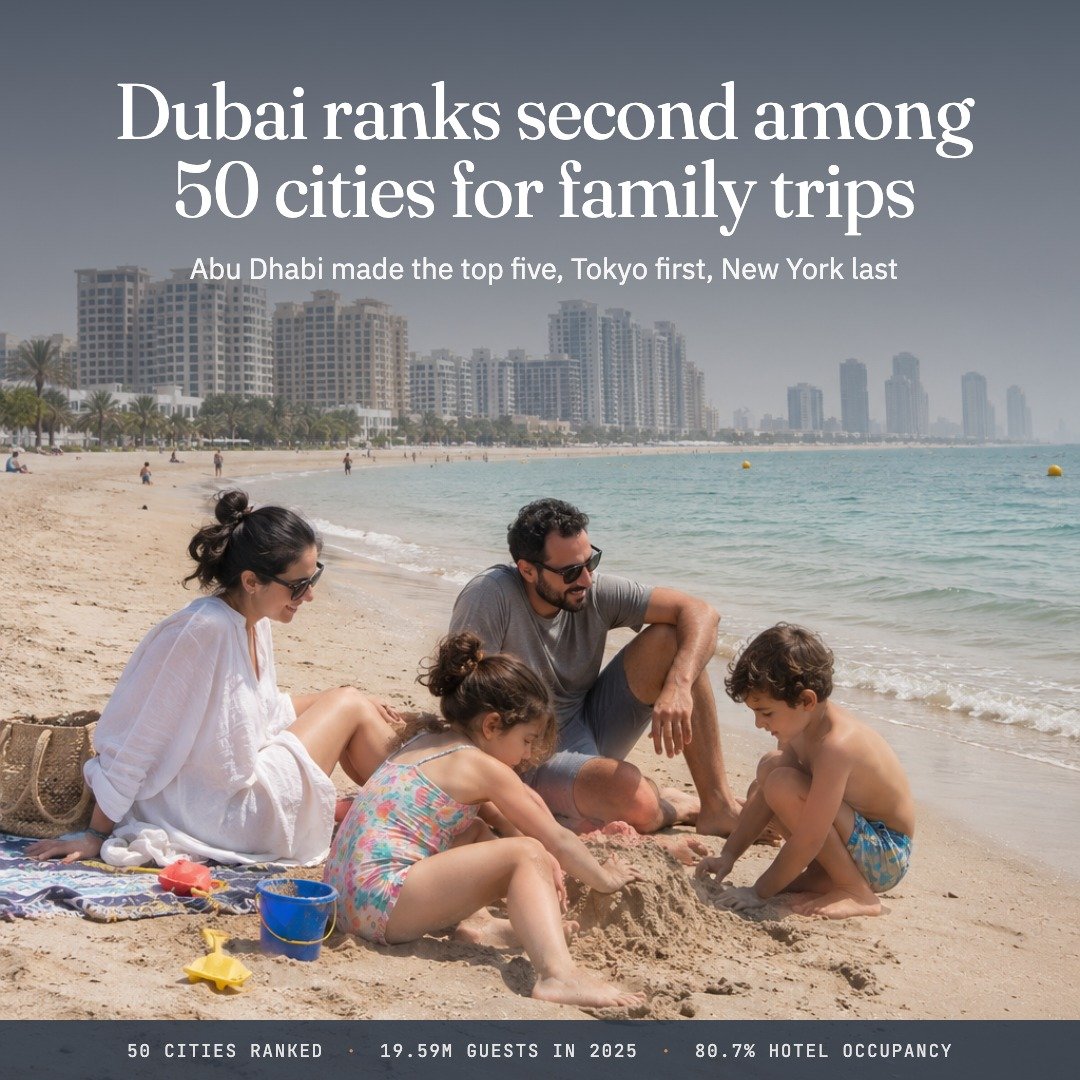
Dubai took second place and Abu Dhabi fifth in a 2026 comparison of 50 major cities for trips with children. Tokyo came first, and New York finished last at 50th. The comparison weighed safety, hotel prices, healthcare and the share of child-friendly attractions. Dubai scored 6.5 out of 10, Abu Dhabi 6.1, and New York 2.3. Both UAE cities shared first place worldwide on the safety index, with 88.7 out of 100.
A travel ranking looks far from a property decision. Our team reads it differently. A family holiday is often the first step of a longer funnel: a trial visit, then repeat stays, then a holiday home, then in some cases a full move with children enrolled in local schools. The ranking measures the top of that funnel, and the sections below follow where it leads.
Safety, hotel cost and the first impression
Families judge a destination on a short list of practical questions. Is it safe to walk in the evening? Can we afford a room big enough for four? Is a doctor nearby? Are there things for children to do within a short drive? The ranking scored cities on exactly these questions, and the UAE did well on all of them.
Abu Dhabi stands out on one measure in particular. It placed second globally for the share of attractions suitable for children, at 29.6%, driven by the Yas Island cluster with Ferrari World, Warner Bros. World, Yas Waterworld and SeaWorld Abu Dhabi. That concentration matters for property because it creates a clear residential catchment. Families who visit Yas Island once tend to ask what living near it would cost.
New York shows the opposite case. It ranked last because of high family hotel costs and weak scores on family infrastructure. Buyers who compare their home city with Dubai or Abu Dhabi often start from that gap in daily cost and safety.
What the tourism numbers say about demand
Dubai welcomed 19.59 million international overnight visitors in 2025, up from 18.72 million in 2024, a rise of 5%. The emirate ended the year with 154,264 hotel rooms across 827 establishments, and average hotel occupancy reached 80.7%. High occupancy on a large room base shows that visitors keep filling new supply, which supports the case for well-located holiday homes.
For buyers, the useful reading is about unit type. Families book larger apartments for longer stays, so two and three-bedroom units near beaches, parks and attractions behave differently from small investor studios. Our analysis suggests that owners of larger units in family-oriented districts compete for a different guest than owners of compact apartments in business districts.
Where tourism turns into residency
The step from visitor to resident is where property demand becomes durable. Dubai's private schools enrolled a record 406,563 students for the 2026 to 2027 school year, up 4.6% from 388,731 the year before. Twenty-six new private educational institutions opened for the new year, including 7 new schools with close to 17,000 places. More children in school means more families living in the city, and families need villas and townhouses with space, parks and school access within walking distance.
This is why mature family master communities in Dubai keep seeing tight supply of ready villas and townhouses. Dubai Hills Estate, Arabian Ranches, Tilal Al Ghaf, Damac Hills and The Valley all sell the same idea: a quiet residential setting with schools and green space inside the neighborhood. Annual rents for three and four-bedroom townhouses and villas in the Maple cluster of Dubai Hills Estate range from 230,000 to 300,000 dirhams, with five-bedroom homes starting around 300,000. In Arabian Ranches 3, comparable townhouses rent from 180,000 to 260,000 dirhams. On Yas Island in Abu Dhabi, the Yas Acres cluster shows rents of 240,000 to 280,000 dirhams for three-bedroom homes.
Buyers can treat those figures as a reference range for family rental yield, not a promise. Rents move with each building, each year and each tenant profile.
The Abu Dhabi angle
Abu Dhabi's fifth place reinforces a trend already visible in its infrastructure pipeline. In May 2025, The Walt Disney Company and Miral announced a Disney resort on the northern waterfront of Yas Island, the seventh in the world. Together with the existing attractions there, it anchors Yas Island as the region's main family entertainment cluster.
For buyers, the practical effect is on the residential side. Family demand concentrates around a single island, so projects with short access to the parks, schools and beaches tend to attract both end users and holiday renters. Buyers should still compare delivery dates, service charges and developer track records, because a strong location does not fix a weak project.
Ras Al Khaimah offers a more affordable family resort alternative. The emirate hosted a record 1.35 million overnight tourists in 2025, with Al Marjan Island at the center of its growth plans. Buyers considering staycation-style investments there should look at the same questions: who will stay, for how long, and what size of unit they will book.
A buyer-side framework
Our team suggests five checks before buying a family-oriented property in the UAE:
- Define the end user first. A holiday renter, a long-term family tenant and an owner-occupier want different layouts and different districts.
- Check the walking radius. Parks, schools and clinics within a short walk matter more to families than a distant landmark view.
- Compare supply by type. Ready villas and townhouses in mature communities are scarce, while apartments are plentiful in many areas.
- Test the rental range against the specific building, not the community average.
- Review the residency rules, since some buyers plan to move their families later.
The golden visa deserves a separate note. The federal portal lists a minimum of 2 million dirhams in property ownership for real estate investors. The Dubai Land Department states that the property must be worth at least 2 million dirhams at purchase and wholly owned by the applicant, and describes a 10-year renewable permit, while the federal page lists a different duration for real estate investments. Buyers should confirm the current terms with the relevant authority before committing.
How our team works with family buyers
We advise on the buyer side. That means we compare projects against the family use case, check ownership structures and flag where marketing language outruns the facts. If you are evaluating a villa, a townhouse or a larger apartment in Dubai, Abu Dhabi or Ras Al Khaimah, our team helps you test the numbers against your own plans before you reserve a unit. Contact the uae-prop team to start with a short review of your requirements.
Frequently asked questions
Does a high family-travel ranking raise property prices?
A ranking does not move prices by itself. It reflects underlying strengths such as safety, healthcare and family infrastructure, which also draw residents. Prices follow supply, location and demand from end users, so buyers should check specific communities.
Which unit types suit families who visit and later relocate?
Two and three-bedroom apartments near beaches and parks suit holiday stays, while three and four-bedroom townhouses and villas in master communities with schools suit long-term residents. The right choice depends on whether the owner plans to rent, live in the property, or do both over time.
Does buying property give a family residency in the UAE?
Property ownership at or above 2 million dirhams can qualify an investor for a golden visa. The conditions and the permit duration differ between the federal and Dubai sources, so buyers should confirm the current rules with the relevant authority before purchase.