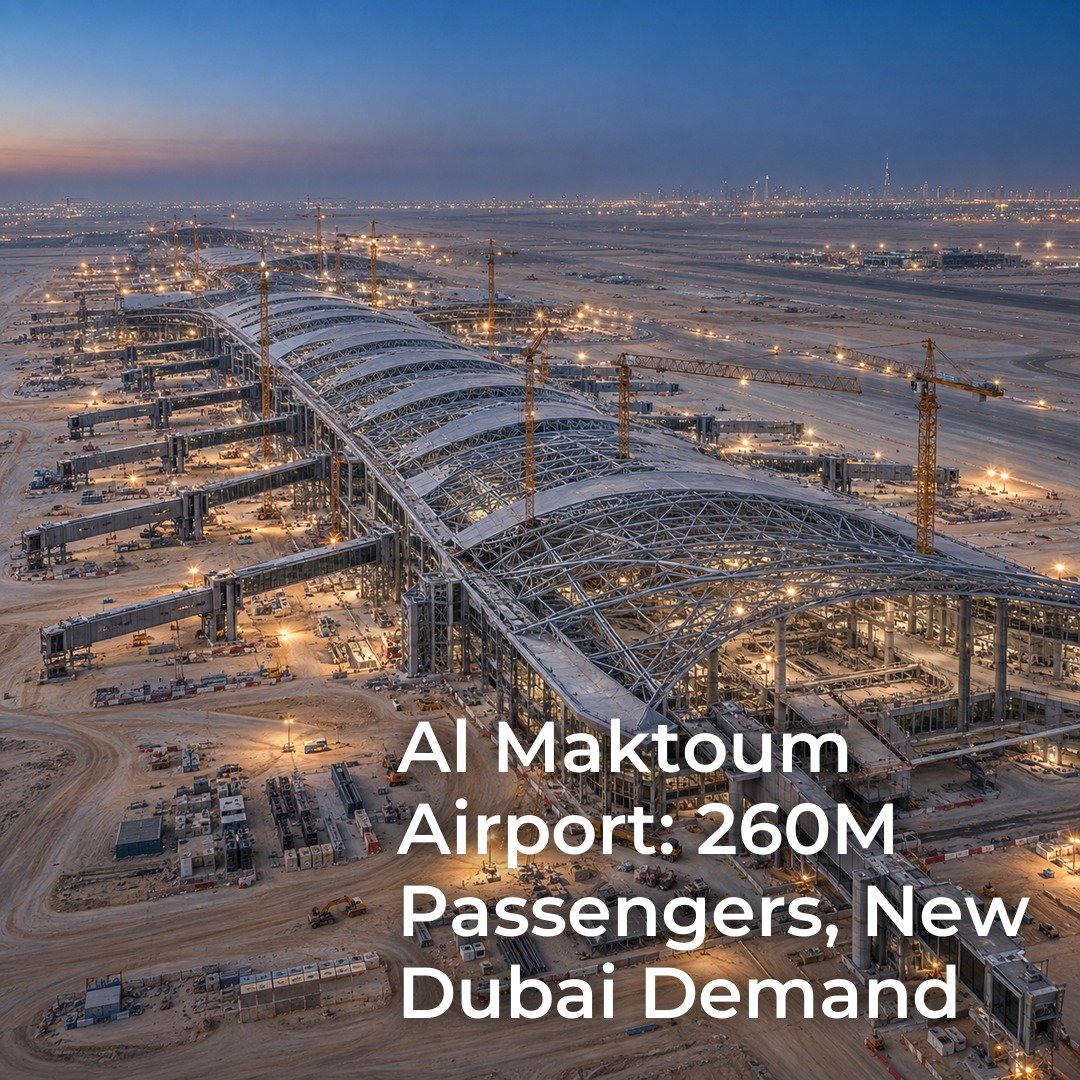

Dubai has confirmed the scale of its next infrastructure bet: Al Maktoum International, inside Dubai World Central, is being built to handle 260 million passengers a year at full build-out. That figure is not an aspiration or a rounding-up of an existing hub. It is the design capacity approved by Dubai's Ruler, backed by an AED 128 billion (roughly USD 35 billion) investment in a new passenger terminal, five runways, and around 400 gates. At that scale, Al Maktoum would sit above every airport operating anywhere in the world today.
Our team tracks infrastructure announcements the way a lender tracks interest rates, because in Dubai the two move the real estate market in similar ways. A rate cut changes financing cost. A confirmed mega-hub changes where 10 million people will live, work and rent over the next two decades. This is one of those announcements.
What is actually being built, and when
The project has phases, and the phasing matters more to an investor than the headline number. The first major phase, centered on a new West Terminal and Concourse 1, is expected to bring the airport to around 150 million passengers a year by approximately 2032. Full capacity, 260 million passengers and 12 million tonnes of cargo annually, arrives in later phases stretching toward 2050. Dubai has also confirmed that Dh55 billion in contracts will be awarded by the end of 2026, which is the clearest signal available right now that this is under active construction, not sitting on a planning document.
The stated plan is for all operations currently at Dubai International (DXB) to shift to Al Maktoum over the coming years. That is a full relocation of a global aviation hub, not an expansion alongside an existing one. DXB today ranks among the busiest airports in the world for international passenger traffic. Al Maktoum is designed to multiply that base, not simply replace it.
Why the "no queues" framing is a real estate signal, not just a travel one
Coverage of the project has leaned on the promise of queue-free processing, built on biometrics and automated flow rather than manual counters. That promise is a UX claim more than a formally measured metric today, but the direction it points to is worth taking seriously. Airports built around automation and premium processing tend to draw a higher-spend traveller segment. That segment shows up downstream in demand for branded residences, serviced apartments, premium rentals and airport-city retail. Infrastructure investment of this kind rarely stays contained to the terminal building. It reshapes the market for kilometres around it.
Where this points on the map
The precedent for what happens next already exists inside Dubai. When DXB expanded and Emirates grew its hub operations through the 2000s and 2010s, the districts around it, Deira, Garhoud, and later Dubai Creek Harbour and Dubai Festival City, saw sustained appreciation and densification as the airport pulled population, jobs and services around itself. Al Maktoum sits inside a different corridor: Dubai South, adjacent to Jebel Ali and Expo City, connected by planned Metro Blue Line extensions and Etihad Rail links. Our analysis of the DWC corridor suggests the same pattern is likely to repeat there, on a larger base, as the first 150-million-passenger phase comes online.
Globally, the closest comparisons are Istanbul Airport and Beijing Daxing, both marketed as next-generation aviation hubs, both planned in the 100 to 200 million passenger range over the long term. Dubai's 260 million target sits meaningfully above both. The aerotropolis model, a city built outward from an airport rather than an airport dropped into an existing city, has precedent in Incheon and Schiphol. Dubai's version is more aggressive on integration with logistics, tourism and free-zone commercial development, and the 12-million-tonne cargo target puts Dubai South on a path to become a genuine global logistics node, not just a passenger gateway.
What this means by investor type
For off-plan buyers looking at Dubai South, Jebel Ali and the wider south-west corridor, a confirmed 260-million-passenger hub is close to a guarantee of long-term demand for nearby residential and hospitality stock: staff housing for airline and airport operations, airport-city hotels, serviced apartments and mid-market communities built for a workforce that does not yet exist at scale. Projects positioned along the coming transport links, rather than isolated from them, stand to see the earliest lift in end-user demand and rental occupancy once the first phase opens around 2032.
For Golden Visa holders, the calculation is less about a single project and more about durability. An approved AED 128 billion megaproject is a strong signal that Dubai intends to remain a global mobility hub for decades, which de-risks long-horizon property decisions in a way that shorter-cycle announcements cannot. It also means new prime zones will emerge outside the traditional Downtown, Marina and Palm clusters, offering entry points before pricing catches up to the infrastructure.
For Dubai-focused investors more broadly, this is best read as a rebalancing event. Demand that has concentrated around the city's established core is likely to spread toward the south-west, following the airport, the rail links and the contract awards. The Dh55 billion in contracts due by the end of 2026 will bring construction jobs and site activity well before the terminal opens, which typically shows up first as rental and staff-housing demand near the works themselves.
For Abu Dhabi-based investors, the calculus is different again. A far larger Dubai hub increases competition for passenger and cargo traffic, but improved inter-emirate rail connectivity also opens dual-emirate strategies, particularly around logistics, warehousing and back-office operations that benefit from proximity to both airports rather than a purely residential bet on either city.
For Ras Al Khaimah investors, the relevant detail is proximity. A feeder hub of this size sitting roughly an hour to ninety minutes away strengthens the tourism case for RAK's resort and hospitality developments, effectively plugging them into a 260-million-passenger arrivals funnel without RAK needing an airport of comparable scale itself. RAK's logistics and industrial zones stand to benefit in parallel from stronger long-haul export connectivity through Al Maktoum.
FAQ
How many passengers will Dubai's new airport handle? Al Maktoum International is designed for 260 million passengers a year at full build-out, with an interim phase of around 150 million passengers a year expected by approximately 2032.
How much is Dubai investing in the new airport? Dubai's Ruler approved a new passenger terminal project at Al Maktoum International with an investment of approximately AED 128 billion, roughly USD 35 billion.
Will Dubai International Airport (DXB) close? Dubai has stated that operations currently at DXB will gradually shift to Al Maktoum International over the coming years, rather than the two hubs continuing to operate at comparable scale in parallel.
When will the first phase of the new airport open? The first major phase, centered on a new West Terminal and Concourse 1, is targeted to deliver around 150 million passengers a year of capacity by approximately 2032.
Which areas benefit most from the airport expansion? Dubai South, Jebel Ali and the wider Expo City corridor sit closest to Al Maktoum and are positioned to see the earliest effects on residential, hospitality and logistics demand as construction and transport links progress.
What is the cargo capacity of the new airport? At full build-out, Al Maktoum International is planned to handle 12 million tonnes of cargo annually, positioning Dubai South as a major global logistics hub alongside its passenger role.
Infrastructure on this scale affects property values without a press release. It shows up years later, in a district that used to be empty land and is suddenly the address everyone wants. Our team helps buyers evaluate where in that timeline a given project actually sits, before the pricing catches up to the plan.