
Dubai Puts AED 2 Billion Behind 48 Urban Centres: What the 2040 Plan Means for Buyers
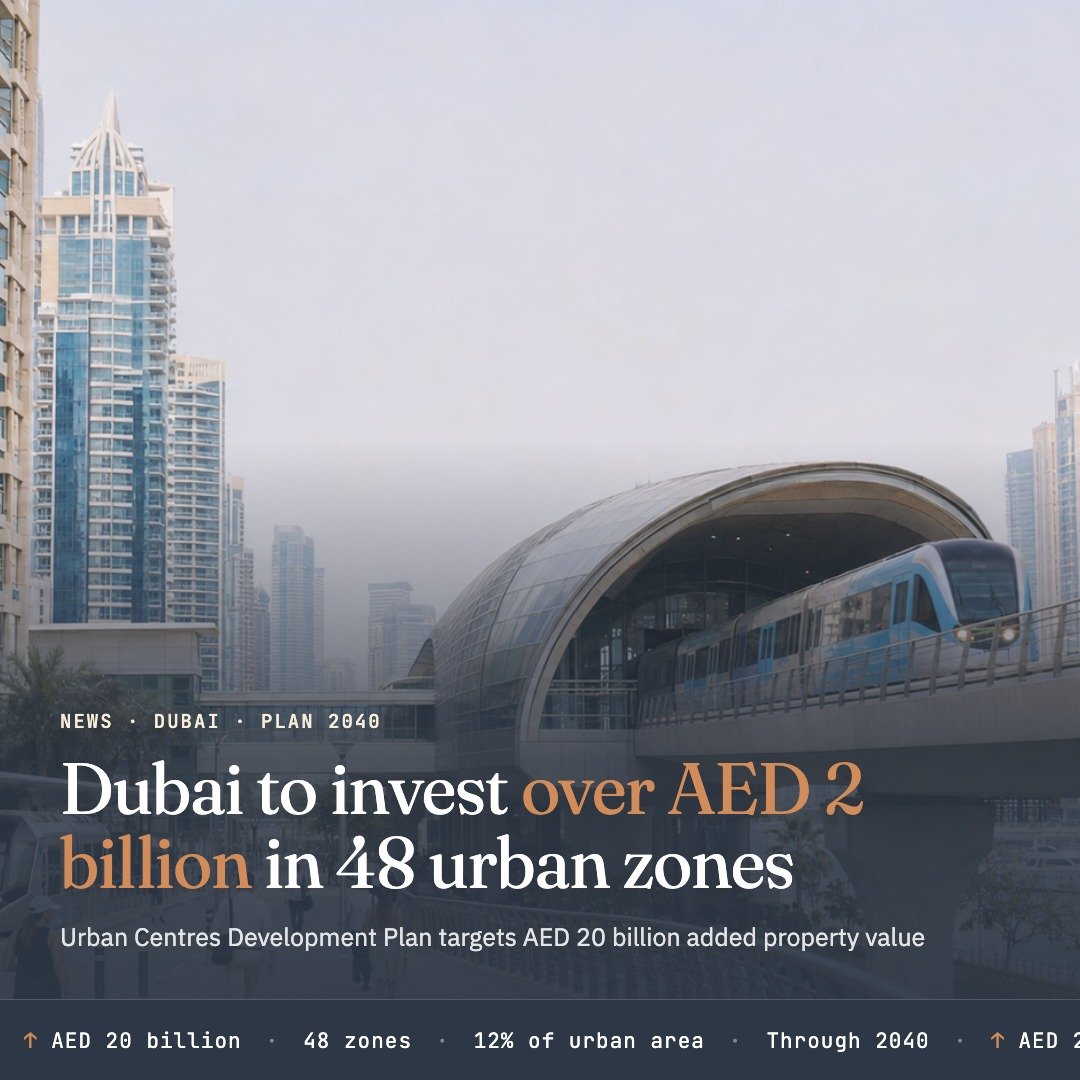
We are tracking AED 2 billion of public money aimed at 48 Dubai districts, with a stated goal of adding AED 20 billion to the value of real estate in those areas by 2040. On October 27, 2026, Sheikh Hamdan bin Mohammed bin Rashid Al Maktoum, Crown Prince of Dubai and Chairman of The Executive Council, approved the Urban Centres Development Plan. For buyers, the useful question is where the money lands, what it pays for, and how a purchase decision should respond.
What the plan covers
The 48 zones break down into 6 main urban centres and 42 supporting sub-centres. Together they cover 12% of Dubai's urban area. The plan was developed under the Supreme Committee for Urban Planning with Dubai Municipality as an execution partner, and it sits inside the Dubai 2040 Urban Master Plan and the D33 economic agenda. That matters because it ties the spending to documents that already shape zoning, transport and population targets.
The budget exceeds AED 2 billion, roughly USD 545 million, and runs through 2040. The projected uplift is AED 20 billion, roughly USD 5.45 billion. That is a ten-to-one ratio between public spending and expected added property value. Our team treats any projection of this kind as a target and reads it as a statement of intent about where the city wants people, jobs and shops to gather.
The transit target
The headline mobility number is 74%. Today about 52% of residents live close to metro or mass transit stations, and the plan raises that share to 74% by 2040, a gain of 22 percentage points. Public and municipal service coverage in the targeted districts is meant to climb from 74% to 85% over the same period.
Behind both numbers sits the 20-minute city idea. A resident should reach 80% of daily needs within a 20-minute walk or bike ride. For a buyer, this describes a product. A flat in a district where school, clinic, grocery and station sit inside one short walk behaves differently over a holding period than a flat that requires a car for each errand. Tenants pay for that convenience, and resale buyers do too.
Why transit proximity has a track record
Dubai has already run this experiment. Since the Red Line opened on September 9, 2009, and the 15-kilometer, 7-station extension to Expo City launched in 2021, residential towers within a 5 to 15 minute walk of stations have consistently shown stronger occupancy and capital growth than comparable car-dependent buildings. The 2040 plan extends that logic from a few corridors to a deliberate network of centres.
The next piece of the network is the Blue Line, a 30-kilometer, 14-station line backed by AED 20.5 billion of transport authority investment and scheduled to open on September 9, 2029. Transport authority studies forecast an uplift of up to 25% in property values around its stations by 2040. The Urban Centres Plan and the Blue Line work as a pair. One decides where density and services concentrate, and the other delivers the rail that connects them.
Two companion decisions from the same session
The Executive Council approved two further measures on the same day. The first is a Sustainable Population Planning Policy, which aligns demographic growth and talent attraction with the capacity of housing and infrastructure. The Dubai 2040 master plan prepares for 5.8 million residents, up from 3.3 million in 2021 and above 3.8 million now. Planning for that growth in a managed way reduces the risk of demand outrunning supply of services.
The second is a Digital Authorisation System through UAE PASS. Individuals and companies can issue secure, paperless powers of attorney for government transactions without visiting a notary in person. Overseas owners gain a practical benefit here. Handovers, leasing and resales can be managed remotely, with less delay and fewer paper trails.
How we read this for buyers
Three practical conclusions follow from the numbers.
Follow the footprint
Public spending is concentrated in 12% of the urban area. Buyers who want exposure to the projected uplift have a clear screen to apply. Projects inside the 48 zones, and ideally within an 800-meter walk (5 to 10 minutes) of an existing or planned station, sit closest to where the money and the services are headed. Isolated plots on the periphery sit outside that logic, even when the price per square foot looks attractive.
Match the handover to the rail
For off-plan buyers, the calendar is the lever. A purchase in 2026 or 2027 with handover close to the Blue Line opening in September 2029 lets a buyer use a developer payment plan, such as 60/40 or 50/50, while the station-proximity premium is still ahead. The projected premium of up to 25% is an estimate, so we advise underwriting each deal as if only part of it arrives, and checking that the building would still work as an investment at today's price.
Respect the Golden Visa threshold
The 10-year UAE real estate Golden Visa requires property worth at least AED 2 million, for ready or off-plan units, and the earlier AED 1 million down-payment requirement was removed in 2024. A buyer who places AED 2 million or more into one of the 48 zones links residency eligibility to an area where service coverage and transit access are both scheduled to improve. That combination supports the asset through weaker parts of the market cycle.
Dubai in a wider UAE portfolio
Our advisory desk looks at Dubai as one part of a UAE-wide allocation. Dubai suits the core of a portfolio, with gross rental yields of roughly 6% to 10%, deep secondary-market liquidity and state-backed transit growth. Abu Dhabi, anchored by Saadiyat, Yas and Al Maryah islands, saw prime sales and rents rise 10% to 20% year on year, and it suits lower-turnover wealth preservation. Ras Al Khaimah offers an event-driven hospitality story built around the USD 5.1 billion Wynn Al Marjan Island resort, planned to open in early 2027. Many sophisticated buyers pair a shorter-horizon holiday-home position in Ras Al Khaimah with the longer compounding of Dubai's urban centres, which run from 2029 to 2040.
What to verify before buying
Neighbourhood lists for the 48 zones, the exact station locations and the delivery schedule of each service upgrade should be confirmed against official documents before a reservation is signed. The AED 20 billion figure is an aggregate across all zones, so individual buildings will see very different results. A well-located tower in a main centre with a short walk to a station will probably capture more of the benefit than a distant unit in a sub-centre with limited services. Our team compares each candidate on walking distance to the station, current service coverage, the developer's delivery record and the entry price against nearby completed stock.
Questions buyers ask us
Does the AED 20 billion uplift apply to every property in the 48 zones?
No. The figure is a projected aggregate for the targeted areas by 2040, and it is an official estimate. Each building depends on its distance from a station, the quality of its surroundings, and the price paid at entry. Buyers should treat the number as a directional signal for the district and run separate numbers for the unit.
Is it better to buy ready or off-plan around the new centres?
Both routes work, and they serve different goals. Ready units give immediate rental income and a visible street environment. Off-plan units with handover near the Blue Line opening in September 2029 offer lower entry prices and staged payments, with the projected station premium still ahead. We usually suggest ready stock for income-focused buyers and off-plan for those with a three-to-five year horizon.
How does the digital authorisation system help overseas owners?
Powers of attorney for government transactions can now be issued digitally through UAE PASS, with no in-person notary visit. An owner abroad can authorise a representative to complete a handover, sign a lease or close a resale. That shortens timelines and lowers the cost of managing a Dubai property from another country.
Anyone considering a purchase near the new centres is welcome to talk to the uae-prop team. Our advisors review the shortlist from the buyer's side of the table, check distances and delivery dates against official sources, and compare the numbers across Dubai, Abu Dhabi and Ras Al Khaimah before a single dirham is committed.