
The Boring Company's 150 Kilometers of UAE Tunnels: What Buyers Should Actually Watch
Elon Musk's The Boring Company has signed a new agreement with the UAE to build more than 150 kilometers of tunnels across the country. The deal runs alongside, and separately from, the Dubai Loop pilot that is already under construction between DIFC and Dubai Mall. Behind it sits a funding round of roughly $3 billion, about Dh11 billion, raised specifically to back UAE tunnel infrastructure. That detail matters more than the headline number. A private venture chasing a moonshot is one kind of story. A state-anchored infrastructure program with a funded construction pipeline is another, and it changes how buyers should read the announcement.
Most coverage of the deal focuses on scale: 150 kilometers, a $3 billion raise, autonomous Tesla vehicles running underground. Buyers we work with tend to skip past the part that actually affects a purchase decision, which is timing. Infrastructure gets priced into land values long before it opens to the public, and it gets priced in fastest around the segments that are already funded and under construction rather than the ones that only exist on a map. Right now, that means the Dubai Loop pilot corridor, not the broader 150-kilometer network, which is still at the agreement stage.
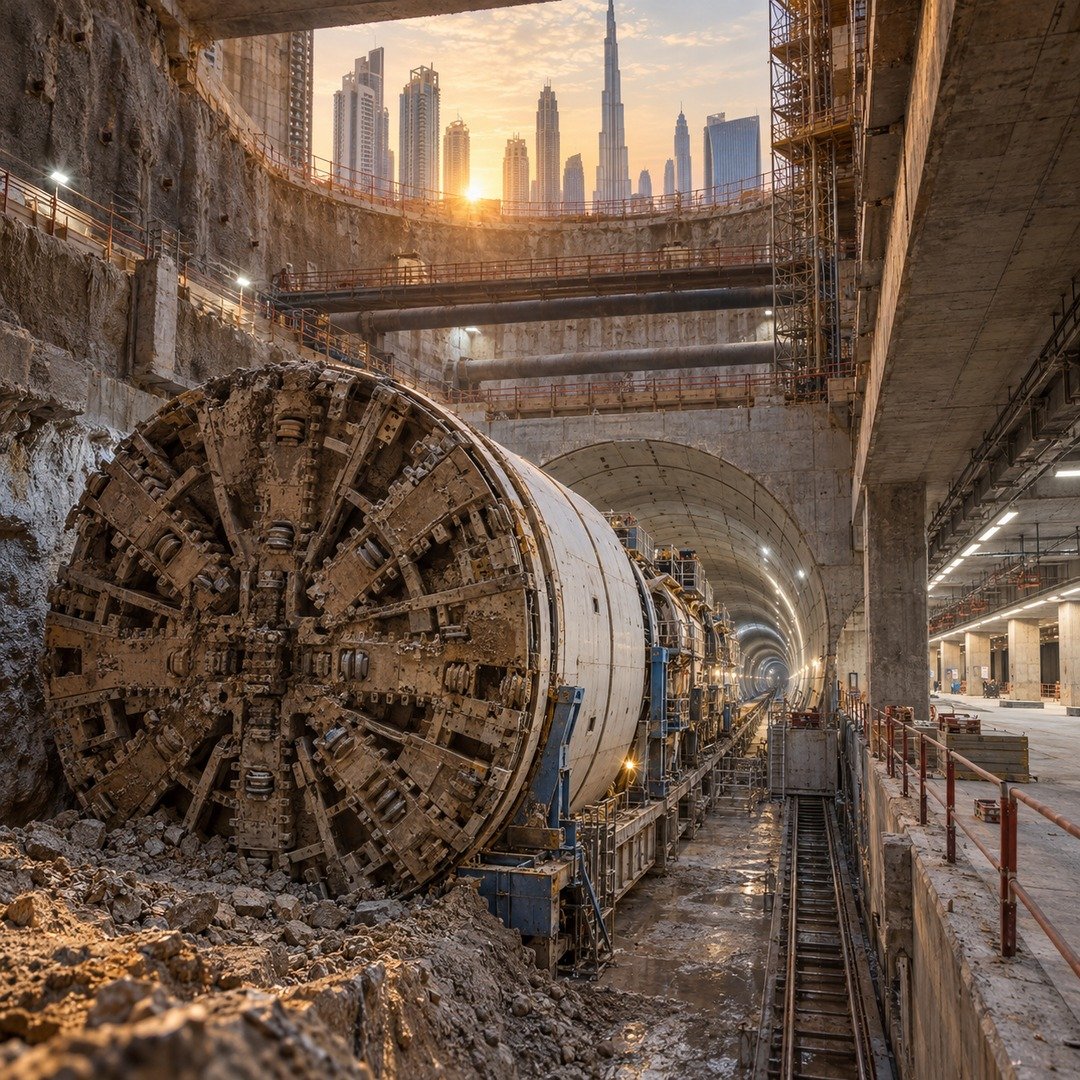
The pilot itself is concrete, in both senses. It runs 6.4 kilometers and connects four stations: Burj Khalifa/Dubai Mall, DIFC 2, Zabeel Dubai Mall Parking, and ICD Brookfield Place. The Roads and Transport Authority signed the construction contract for this phase in February 2026, with a budget of about Dh565 million. Precast concrete segment production for the tunnel has already started, and active boring is expected to begin by the end of 2026. None of that is speculative. It is a funded, scheduled build with a government transport authority as a construction partner, which is a different risk profile from a proposed route that exists only in a press release.
The bigger picture goes further. The Boring Company's stated target for the full Dubai Loop is an expansion to roughly 22 to 22.5 kilometers with 19 stations, linking Dubai World Trade Centre, the DIFC financial district, and Business Bay. That full build has not been contracted the way the pilot has. Treat it as a directional signal for where value is likely to concentrate over the next several years, not as a basis for pricing a purchase today. The distinction between funded phase and mapped future phase is the single most useful filter for anyone evaluating a project on the strength of this news.
What the pilot changes in practical terms is travel time inside Dubai's densest commercial corridor. A trip between DIFC and Dubai Mall currently takes around 20 minutes by road. Once the Loop is running, that drops to roughly 3 minutes, using autonomous vehicles moving through a dedicated tunnel rather than competing with surface traffic. For an office tenant, a retail operator, or a resident of a building near one of the four stations, that is not a marginal convenience. It is a structural change in how connected that address is to the rest of the financial district, and connectivity of that kind has historically shown up in both rental demand and resale pricing.
We have seen this pattern before, just with a different mode of transport. When Dubai Metro stations opened around Dubai Marina, JLT, and Downtown, properties within walking distance saw capital values and rents move ahead of comparable stock further from a station. The mechanism is straightforward: reduced commute friction expands the pool of tenants and buyers willing to consider a building, and that expanded demand shows up in price. Dubai Loop is a narrower version of the same effect, aimed specifically at connecting a handful of trophy addresses inside the CBD rather than serving mass transit across the city. That narrower focus is worth sitting with. This is not a metro line built for commuter volume. It is a high-frequency connector built for DIFC, Downtown, and Dubai Mall specifically, which points the likely price effect toward premium offices, branded residences, and prime retail rather than the broader market.
For a buyer already holding or considering property in that corridor, the practical takeaway is to separate the four funded stations from everything else. Proximity to Burj Khalifa/Dubai Mall, DIFC 2, Zabeel Dubai Mall Parking, or ICD Brookfield Place sits on a contracted, budgeted, government-partnered construction timeline. A developer marketing a project as near a future Loop station outside those four points is selling a possibility, not a schedule. Our approach when we evaluate a listing against this kind of infrastructure news is to ask a developer for the actual station name and distance, then check that station against what is currently funded rather than what is on the long-term concept map. That single question filters out most of the marketing noise attached to a story like this one.
The wider 150-kilometer UAE agreement adds a second layer worth watching over a longer horizon. It signals that the government sees underground autonomous transit as infrastructure policy, not a one-off pilot confined to central Dubai. For an investor holding assets across Dubai, Abu Dhabi, and Ras Al Khaimah, that is an early signal rather than an actionable one. No routes outside Dubai Loop have been named yet. The value of the signal is in what it tells you about long-term direction: capital and government backing are aligned behind this transport model, which raises the odds that today's early, less obvious locations get their own infrastructure announcement later. Buyers with a longer holding period can treat that as a reason to track the space rather than a reason to buy on the strength of the headline.
Our role in a moment like this is to slow the story down to what is actually built, funded, and contracted, and separate that from what is still a target on a slide. The Dubai Loop pilot is real, budgeted, and moving toward active construction. The 150-kilometer national network is a funded intention with no fixed routes yet. Both are worth watching. Only one of them should currently affect how you price a specific address.
Frequently asked questions
Is the Dubai Loop the same project as the new 150-kilometer UAE tunnel agreement? No. Dubai Loop is a separate, earlier contract between The Boring Company and Dubai's Roads and Transport Authority, already under construction. The 150-kilometer agreement is a new, broader deal covering tunnel development across the UAE and does not yet have named routes outside the Dubai Loop pilot.
How far along is construction on the Dubai Loop pilot? The RTA signed the construction contract in February 2026. Precast concrete segments for the tunnel are already in production, and active tunnel boring is expected to start by the end of 2026. The pilot phase carries a budget of roughly Dh565 million.
Which stations are actually funded right now? Four: Burj Khalifa/Dubai Mall, DIFC 2, Zabeel Dubai Mall Parking, and ICD Brookfield Place, covering a 6.4-kilometer route between DIFC and Dubai Mall. The full 19-station, 22 to 22.5-kilometer expansion is a stated target, not yet a contracted build.
Should I buy property because a developer says it will be near a future Loop station? Treat that claim carefully. Only the four stations above are currently under a signed construction contract. Ask for the exact station name and confirm it against the funded pilot before treating proximity as a pricing factor.
Will this reduce commute times inside Dubai's business district? Once operational, the pilot is expected to cut the DIFC to Dubai Mall trip from around 20 minutes by road to roughly 3 minutes through the tunnel, using autonomous vehicles on a dedicated route separate from surface traffic.
Does this affect property outside Dubai? Not directly yet. The 150-kilometer national agreement signals government appetite for tunnel infrastructure beyond Dubai, but no specific routes in Abu Dhabi, Ras Al Khaimah, or elsewhere have been announced. Investors in those markets should treat it as a trend to monitor rather than a basis for near-term pricing decisions.
If you are weighing a purchase near DIFC, Downtown, or Business Bay against this news, our team can walk through which claims are backed by a signed contract and which are still marketing language attached to a concept map.