
UAE Builds a Predictive Shield Against Bad Air, and Property Managers Are Paying Attention
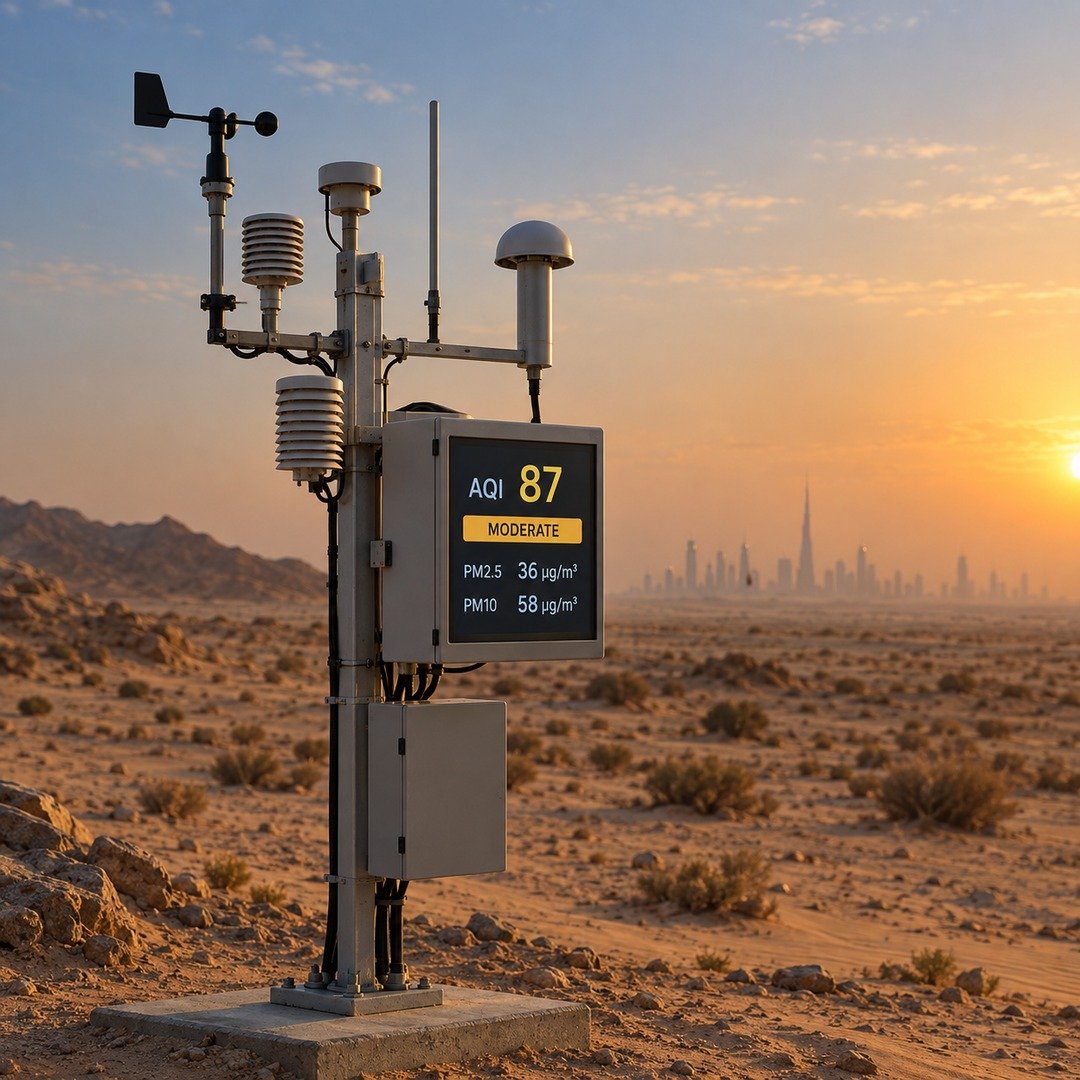
Air quality in the UAE has moved from a monitoring exercise to a forecasting discipline. National authorities are assembling an early-warning system that draws on real-time sensor networks in Abu Dhabi and Dubai, layering meteorological data and AI models on top so pollution episodes can be flagged before they hit residential areas, not just logged after the fact.
The shift matters because it changes what "environmental due diligence" means for a buyer evaluating a project near a port, an industrial corridor, or a busy highway.
From counting particles to predicting them
The UAE's National Air Quality Platform already pulls a live, country-wide view of conditions from monitoring stations across the emirates. What is new is the forecasting layer sitting on top of that data. Abu Dhabi's Environment Agency runs an automated system using artificial intelligence and high-performance cloud computing that predicts dust and pollutant concentrations up to 72 hours ahead, giving planners and residents a three-day runway instead of a same-day alert.
Dubai has taken a parallel, more physical approach. A new station in Jebel Ali, built at a cost of Dh2 million and carrying 11 sensors, can measure 101 distinct pollutant types. Its placement near the port and free zone is not incidental. It sits inside the Dubai Quality of Life Strategy 2033, a framework that treats air quality as a livability metric the same way schools or transit access get treated. Dubai Municipality backs this with a Mobile Environmental Air Monitoring Lab, the first tool of its kind in the region, built to reach locations a fixed station cannot cover.
Abu Dhabi is going a layer deeper still with a digital twin of the emirate's environment. The first phase, running for 12 months, focuses on deploying IoT devices and predictive models to simulate scenarios such as industrial emissions or storm-driven dust events before they happen. That is a planning tool as much as an environmental one: a digital twin lets regulators test how a proposed development or industrial expansion would affect air quality before construction, not after complaints arrive.
Why this reaches the property market
For an investor comparing off-plan projects, environmental risk used to be an invisible variable. A community could sit downwind of an industrial zone or a busy corridor, and buyers had little way to know how monitored, or unmonitored, that exposure was. A forecasting network changes the visibility of that risk. Projects near Jebel Ali, for instance, now sit inside a monitoring zone that tracks 101 pollutant categories in real time, giving a buyer a documented baseline rather than a guess.
The same logic applies to Abu Dhabi's permitting process. Once environmental data feeds directly into how new developments and industrial expansions get approved, projects are more likely to be screened for emissions impact before they break ground. That reduces a specific kind of long-tail risk: the possibility that a project approved today turns out to sit next to an emissions source discovered years later.
Golden Visa holders, who by definition are planning around a decade-long horizon rather than a resale cycle, read this differently again. Their calculation includes air quality as a health variable, not just a comfort one. A national system built to anticipate dust storms and pollution spikes, rather than just report them, supports the kind of policy continuity that a ten-year resident actually needs: consistent standards, not periodic responses to bad air days.
Reading the numbers as an investor
None of this is presented as a marketing gesture. The scale is functional. Forty-one monitoring stations already feed the national AQI system, supplemented by satellite data for accuracy in areas without ground sensors. The UAE's National Air Quality Agenda 2031 explicitly names an early-warning system as a strategic target, meaning this is a multi-year build-out with a stated deadline, not a one-off pilot.
That timeline lines up with a broader shift in how UAE authorities frame the built environment. A country pursuing Net Zero 2050 needs granular emissions data as a baseline, and the integrated climate monitoring system launched to support that goal treats greenhouse gases and air pollutants as two sides of the same measurement problem. For a Dubai or Abu Dhabi off-plan buyer, this shows up less as a single headline and more as a pattern: every new monitoring layer added to the system makes the next development approved under it a little more traceable.
Our view at uae-prop: buyers who ask about proximity to industrial zones, port corridors, or high-traffic arteries now have an actual data source to check, rather than relying on developer assurances. That is a meaningful change in how environmental risk gets priced into a purchase decision, and one we expect more buyers to start asking about directly.
FAQ
Does the UAE have a national air-quality forecasting system? Yes. Authorities are building a national forecasting and early-warning capability that combines monitoring data, meteorological information and AI-based analytical tools, expanding on existing platforms in Abu Dhabi and Dubai.
How far ahead can Abu Dhabi predict air pollution? Abu Dhabi's Environment Agency runs an automated forecasting system that predicts dust and pollutant levels up to 72 hours in advance using AI and cloud computing.
What does Dubai's new Jebel Ali station monitor? The Dh2-million station uses 11 sensors to measure 101 types of air pollutants and operates under the Dubai Quality of Life Strategy 2033.
Why does air-quality monitoring matter for off-plan buyers? It gives buyers a documented environmental baseline for projects near industrial zones, ports or busy corridors, rather than relying on assumptions about exposure.
Is air quality relevant to Golden Visa investment decisions? For long-term residents planning around a decade-long horizon, air quality functions as a health and livability factor, and a national early-warning system supports the policy continuity that long-term holders value.
How many monitoring stations does the UAE currently operate? The national AQI system draws on 41 monitoring stations across the UAE, supplemented by satellite data for broader coverage.
If you are evaluating a project near an industrial corridor, a port, or a high-traffic zone, our team at uae-prop can walk you through the available monitoring data for that specific location before you commit.