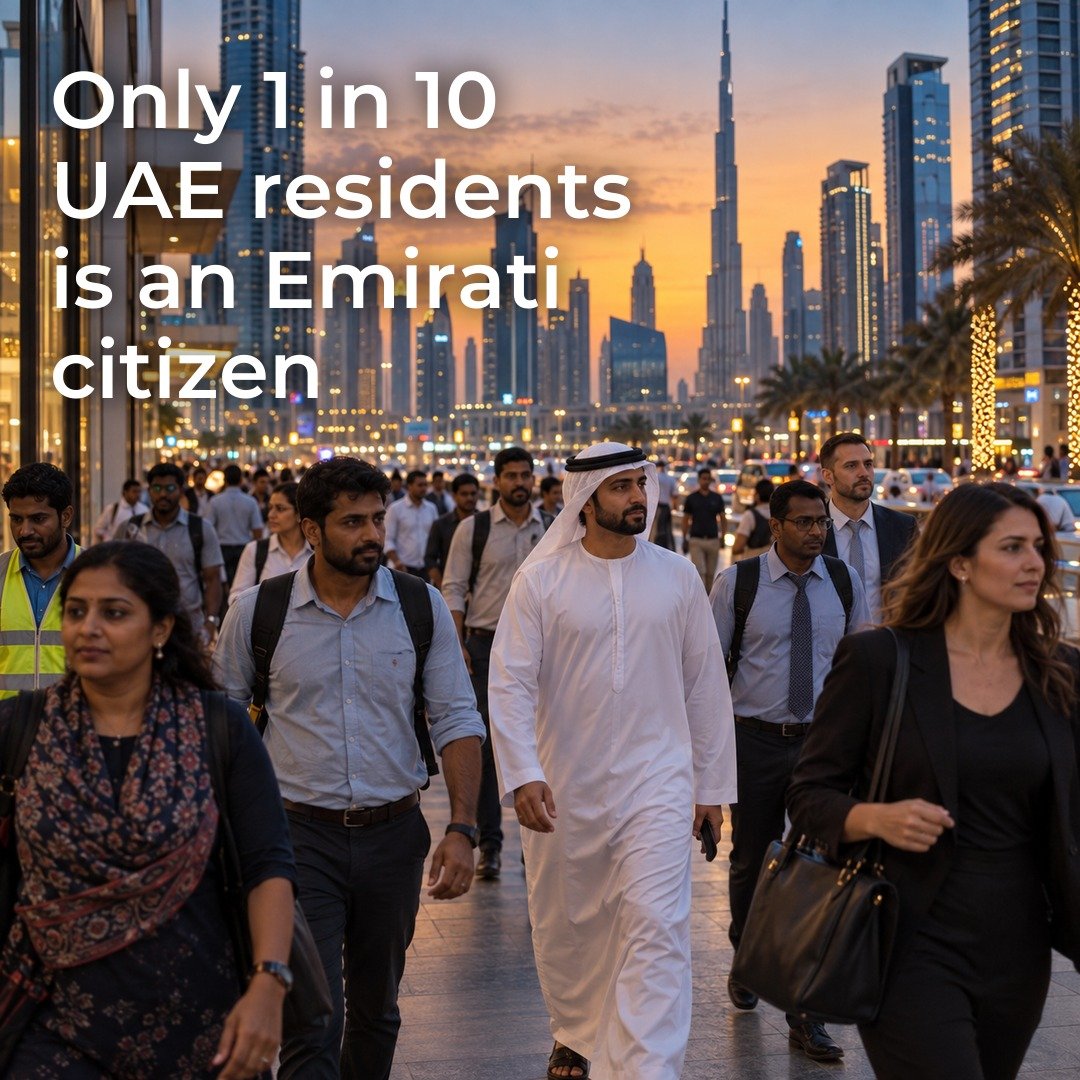

Roughly 11.5 million people live in the UAE. Just over a tenth of them, about 1.15 million, hold an Emirati passport. There are more Indian nationals in the country than there are citizens. That ratio did not emerge from an oil boom or a late-stage construction rush. It is close to the design the country started with. Schools, labor contracts, and housing were built from the beginning around the assumption that most residents would never become citizens, no matter how long they stayed.
Buyers arriving from countries where a growing foreign population gradually reshapes the electorate, or at least the school curriculum, often expect a similar slow assimilation here. It never happens, and it was never supposed to. A finance manager from Mumbai, an engineer from Manila, a teacher from London can spend fifteen years in Dubai, put two children through school, buy an apartment, and renew a visa nine times, remaining exactly as much a temporary resident as the day they landed. The gap between citizen and everyone else is not closing. It is the permanent architecture of the place.
That gap matters more than the headline figure, because it shapes everything downstream. Out of 11.5 million residents, 1.15 million are Emirati. The other roughly ten million run the schools, staff the hospitals, build the towers, manage the funds, and rent or buy nearly all of the private housing stock. When a market is shaped by a population where nine in ten people hold no path to citizenship, every institution built on top of it, from the classroom to the rental contract, has to be designed around renewal rather than settlement.
Look at how schools grew here. A country where citizens are a small minority could not build its education system around a national curriculum for a national population, because there was barely a national population to build it around. British, Indian, and American curricula did not arrive later as an accommodation. They were there from the start, because classrooms filled with the children of residents who were never going to need an Emirati passport to plan their next move. The labor market followed the same logic. Employment has almost always run on renewable contracts tied to a specific job, not a slow track toward permanent status. Losing the job has historically meant losing the right to stay, a structure closer to a long-term visitor arrangement than to conventional immigration.
This is the part that matters most for anyone looking at property here rather than at demographics for their own sake. If nine in ten residents can never naturalize, yet plenty of them stay for a decade or three, the market needed another way to offer something resembling permanence. Freehold ownership in designated zones is that answer. So is the residency visa tied to property investment. Neither turns a buyer into a citizen, and neither was designed to. What both do is let someone who has already decided to spend the next chapter of their working life in Dubai or Abu Dhabi hold an asset here on comparable terms to a citizen, rather than treating every lease as a countdown. Buyers we work with tend to ask about this distinction early, usually once they realize how different it is from the ownership logic they know at home.
The same demographic structure explains something buyers notice once they start comparing this market to almost any other. Rental demand does not soften the way it would in a market with a large, stable, home-owning citizen base. The reason is structural, not cyclical. When the overwhelming majority of the population is here on a renewable footing, a large share of the tenant pool, and a meaningful share of the buyer pool, refreshes every few years by design, not by accident. New arrivals replace departures continuously, in numbers large enough that whole segments of the rental and resale market run on churn instead of on a fixed population settling in for generations.
The single fact that captures all of this best is not the 11.5 million or the 1.15 million. It is that there are more Indian passport holders in this country than there are people who hold its own. No other major property market runs on that arithmetic, and every price, lease, and freehold title here reflects it, whether the person signing the contract notices or not.
Why are citizens such a small share of the UAE population?
Because the state built its labor and residency system around bringing in workers for defined roles rather than growing a settled national population over generations. A ratio of roughly one citizen to every ten residents is not a byproduct of growth. It is close to how the system has run for decades.
Does living in the UAE for many years lead to citizenship?
No, and the residency and property system here was not designed with that path in mind. Long-term residents renew visas, often tied to employment, investment, or property ownership, rather than moving toward naturalization.
How does this demographic structure affect rental demand?
It keeps a large share of the tenant base turning over on a regular cycle, since most residents are here on renewable, job-linked terms rather than settling in permanently. That steady churn is one reason well-located rental units rarely stay empty for long.
What does freehold ownership offer if it does not lead to citizenship?
It gives a non-citizen resident ownership rights comparable to a citizen's within designated zones, often alongside a route to a longer residency visa. It substitutes property-based permanence for a citizenship path that does not exist here.
Are Indian nationals really the largest group in the country?
Yes. There are more people of Indian nationality living in the UAE than there are Emirati citizens, a gap that reflects how the labor market and residency system were built from the outset around a foreign majority.
Should this demographic makeup change how someone evaluates a property purchase here?
It should change what someone expects from the purchase. Buying into this market means buying into a system built for renewal and mobility, not into the slow-growing, citizen-majority neighborhood model common across much of Europe or North America.