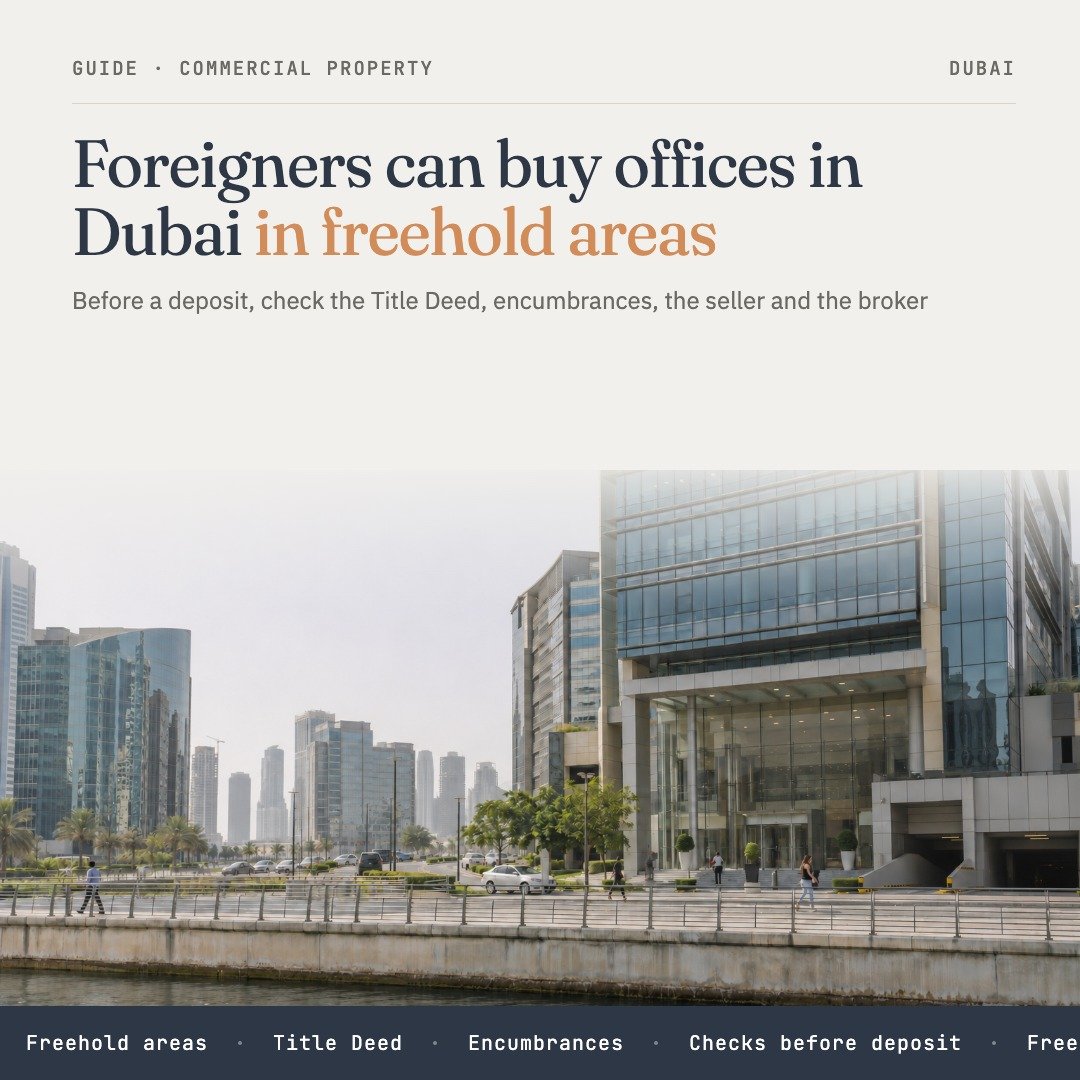

Foreign buyers can own offices in Dubai, but only in places where the law and the Dubai Land Department (DLD) allow it, and that single condition is where most mistakes start. Two buildings on the same street can sit under different ownership rules. A listing that says "freehold office" proves nothing until the paperwork says the same thing. Below is the order of checks our team uses for buyers who want a commercial unit, and the points where we tell people to walk away.
Can foreigners buy commercial property in Dubai?
In short, yes, in designated areas. Dubai regulates foreign ownership by zone. Some areas are designated for freehold ownership by non-UAE nationals, and some are not. Whether a given office tower falls inside a freehold area is a factual question with a documented answer. It does not depend on how the broker describes the building.
We deliberately avoid publishing a fixed list of zones here. The list of areas open to foreign ownership changes, and the only reliable version is the one on the official DLD website on the date you check. Treat any list in an article, a chat group or a sales brochure, including ours, as a starting point for questions and nothing more.
Two more points shape the answer. First, many buyers hold commercial property through a company rather than in their own name. A legal entity is a company registered under UAE rules, and a company can be the owner on the title instead of a person. Second, ownership of the unit is one matter and the right to run a business from it is another. A Title Deed proves who owns the space. It does not by itself prove you may operate a particular business there. We cover that gap further down.
How is buying an office different from buying an apartment?
The mechanics of transfer feel similar. A buyer and seller agree terms, the transfer is registered with DLD, and a Title Deed (the official certificate of ownership) is issued in the new owner's name. The differences sit around the edges, and they are the part that costs money when missed.
An apartment is judged mostly on location, view and price per square foot. An office adds layers. The permitted use of the unit matters, because a space registered for one type of activity may not suit your business. The building's management matters, because service charges, parking allocation and access rules for staff and visitors are set at building level. The tenant situation matters, because many offices are sold with a lease in place, and the lease terms become your terms on the day of transfer.
There is also a practical difference in how buyers use the space. A buyer of an apartment usually either lives in it or rents it to a household. A buyer of an office usually needs a business reason: a registered company, a licence issued for that address, or a tenant whose licence is tied to it. If none of those is in place, the property can sit empty, and an empty office produces service charges and no income.
For a full view of what a transfer costs, read our breakdown of DLD fees and transaction costs in Dubai. Commercial purchases carry the same registration logic, and the cost lines are worth seeing before you negotiate a price.
Who should think twice before buying an office?
We would rather say this early. An office purchase suits buyers with a defined use: their own company moving into the space, or a documented tenant. It suits less well a buyer who wants a passive investment and expects the process to match buying a residential apartment. Commercial units depend more heavily on the lease, the building's occupancy and the quality of the management company. Vacancy can last longer, and the tenant pool is narrower.
It also suits less well a buyer who cannot visit or appoint someone to inspect on their behalf. Several checks below require documents to be requested in writing, and they get skipped when nobody is pushing for them.
What should you check about the seller's right to sell?
Start with the person across the table. The seller must be the registered owner, or must hold documented authority to act for the owner. The check has three parts.
The first is the title. Ask for a copy of the Title Deed and confirm that the name on it matches the seller's identification, or the company documents if the owner is a company. A seller who offers a different document in its place, or who says the deed is "being updated", has just given you a reason to pause the deal.
The second is authority. If someone sells on behalf of the owner, request a power of attorney and confirm in writing that it covers the sale of this specific unit. A power of attorney that is general, expired or issued for a different purpose is a problem you should solve before any money moves.
The third is encumbrances. A mortgage, a lien or a registered dispute can sit against a unit while the listing still looks clean. Ask the seller to state in writing whether the property is mortgaged. If it is, the lender's involvement and the mechanism for clearing the mortgage at transfer need to be written into the sale terms, because the lender's release is part of how title passes cleanly.
What can you verify online, and what only in writing?
This is the question buyers ask least and should ask first. DLD publishes official information and offers services through its website and approved channels, and some basic property and ownership data can be confirmed through them. The right way to use that is to confirm what is available to you on the day, using the official pages, and to treat anything that cannot be confirmed there as a written request.
In our experience the split looks like this. Things you can usually start checking through official channels: that the area is designated for the kind of ownership you intend, that the property is registered, and that the registered details match the listing. Things that typically need a document or a written statement from a person or an authority: the seller's authority to sell, the existence of a mortgage or other claim, the status of service charges, and the use permitted for the unit.
If you cannot tell which category a given check belongs to, ask DLD or the licensed broker directly and keep the answer in writing. A verbal "it's fine" has no value once the deposit is paid.
What should you request from the seller and the building management?
Gather documents in two streams, one from each side.
From the seller, ask for the Title Deed, the seller's identification or company documents, any power of attorney, the current lease and tenant details if the office is rented, and a written statement about any mortgage. Ask also for the sale agreement draft early, so that you read its conditions before you feel committed.
From the building's management company, ask for a statement of service charges and whether any are unpaid. Unpaid charges are generally a matter to settle before or at transfer, and you want to know the figure before agreeing a price. Ask for the building's rules on signage, access hours, parking allocation and fit-out works, since these decide whether your staff and clients can use the space as you imagine. Ask also whether any building-wide works or special levies are planned.
Do not rely on the seller to relay answers from the management company. Contact the management company yourself, or have your adviser do it, and keep the replies.
How do you confirm the office suits your business activity?
This is the check that separates a good purchase from an expensive mistake. Owning the unit does not automatically entitle you to run any business from it.
Confirm the registered or permitted use of the unit and compare it with what you plan to do. A consultancy, a clinic, a trading desk and a call centre make very different demands on a space, from power and ventilation to occupancy limits and public access. Then confirm how the licensing authority for your intended activity treats the address. Whether you need a licence tied to a physical office, and which authority issues it, depends on the activity and on where the building sits, so confirm both with the relevant authority rather than assuming.
A useful test is to write a single sentence: "I will run this business from this unit, under this licence, issued by this authority." If you cannot complete the sentence with names and documents, the purchase is not ready.
What is the role of a broker, and what should you check about them?
A broker's work in a commercial deal is to bring documents and facts into one place, and to keep the process on a timetable. A good one asks you what business you plan to run before showing a single unit.
Verify that the broker and the brokerage are licensed in Dubai and that the licence is current. Ask who they represent. If the same agent represents both buyer and seller, you need to know that before sharing your budget. Ask how they are paid and what the fee covers, and get it in writing.
Treat a broker who rushes you with suspicion. Phrases such as "another buyer is coming this afternoon" or "the owner wants a deposit today" are standard pressure, and in a market with many listings they rarely reflect reality. A broker who welcomes your requests for documents is behaving like one who expects the documents to hold up.
If you want a sense of the numbers before speaking to anyone, our ROI calculator lets you test income and cost assumptions on a unit before you commit to viewings.
Which red flags should stop a deal?
These are the signals we treat as reasons to pause, in rough order of seriousness.
The seller cannot or will not show a Title Deed. The name on the deed differs from the person selling, with no documented authority. The area's ownership status is described vaguely, with phrases like "foreigners can buy here, no problem" and no reference to an official source. The seller or broker asks for a deposit before you have seen the documents. The sale price sits well below comparable units in the same building without a clear explanation. The listing details, such as size, floor or unit number, differ between the advertisement and the registered record. The seller refuses a written statement about mortgages or charges. A payment request arrives for an account that does not match the seller or a regulated channel.
None of these proves fraud on its own. Each one is an unanswered question, and an unanswered question is enough reason to stop paying.
What is the step-by-step order of checks before a deposit?
We suggest this sequence, and we suggest finishing every step before a deposit changes hands.
Step one: define the business use. Write down the activity, the headcount and the licence you expect to need.
Step two: confirm the area. Check the official DLD information on the date you are buying to see whether the area is open to ownership by your type of buyer, whether a person or a company.
Step three: ask the seller for the Title Deed, identification or company papers, any power of attorney and a written statement on mortgages.
Step four: compare the documents with the listing. Name, unit number, size and floor should agree everywhere.
Step five: contact the building management and request the service charge statement, the building rules and details of any planned works or levies.
Step six: confirm permitted use and licensing for your activity with the relevant authority.
Step seven: if the unit is let, read the lease and confirm the tenant's details, term and rent. Decide whether you accept those terms as your own.
Step eight: model the total cost, including registration, fees, service charges and any fit-out, and set it against your plan.
Step nine: read the sale agreement in full, ideally with independent advice, and confirm that the conditions you care about, such as the release of any mortgage and the handling of unpaid charges, appear in writing.
Only then pay a deposit, and only to an account and through a channel that you have confirmed matches the seller and the sale agreement.
How do you buy commercial property in Dubai without surprises?
The pattern behind most failed deals is the same. A buyer fell in love with a unit, trusted a verbal assurance, and paid before the paperwork was complete. The buyers who avoid that are the ones who treated every claim as a question to be documented.
Our advice is plain. Keep the process slow at the start and quick at the end. Insist that each check produces a document or a written answer. Keep every message. If the other side resists a reasonable request, take that as information about how the rest of the transaction will go.
Buyers who ask us about office purchases usually arrive with a price in mind. The more useful starting point is the sentence about the business: what will happen in this space, under which licence, and who will answer if something goes wrong. A unit can pass every title check and still be the wrong place for the work you intend to do.
FAQ
Can you buy commercial property in the UAE as a foreigner?
Yes, where the law permits foreign ownership of the area in question. Ownership rules differ by emirate and by zone, so the answer for a specific unit depends on where the building stands. Confirm the status with official sources such as DLD on the day you buy, and ask for the confirmation in writing.
How do you buy commercial property in Dubai step by step?
Define your business use, confirm the area is open to your type of buyer, request the Title Deed and seller documents, verify with the building management, confirm permitted use and licensing, read any lease, model the full cost, review the sale agreement, and only then pay a deposit through a confirmed channel. The steps above give the full sequence.
Where to buy commercial property in Dubai?
Where you buy depends on your activity, your clients and your licence, and on whether the area is open to foreign ownership. Start from the use of the space, then check the area's status through official DLD information. Choosing a district first and the business second is the usual cause of a poor fit.
If you want a second pair of eyes on a specific office before you pay a deposit, our team offers a free consultation on buying an office. We review the documents with you and tell you plainly where we see gaps.
Sources
- Dubai Land Department. Official website, real estate information and services. Page content current on the date of access. https://dubailand.gov.ae/en/. Accessed November 12, 2026.
- Dubai Land Department. E-services. Page content current on the date of access. https://dubailand.gov.ae/en/eservices/. Accessed November 12, 2026.
- Dubai Land Department. Real estate data (open data). Page content current on the date of access. https://dubailand.gov.ae/en/open-data/real-estate-data/. Accessed November 12, 2026.