
Dubai Metro Route 2020 Extension to Al Maktoum Airport: What Buyers Should Weigh Before 2031
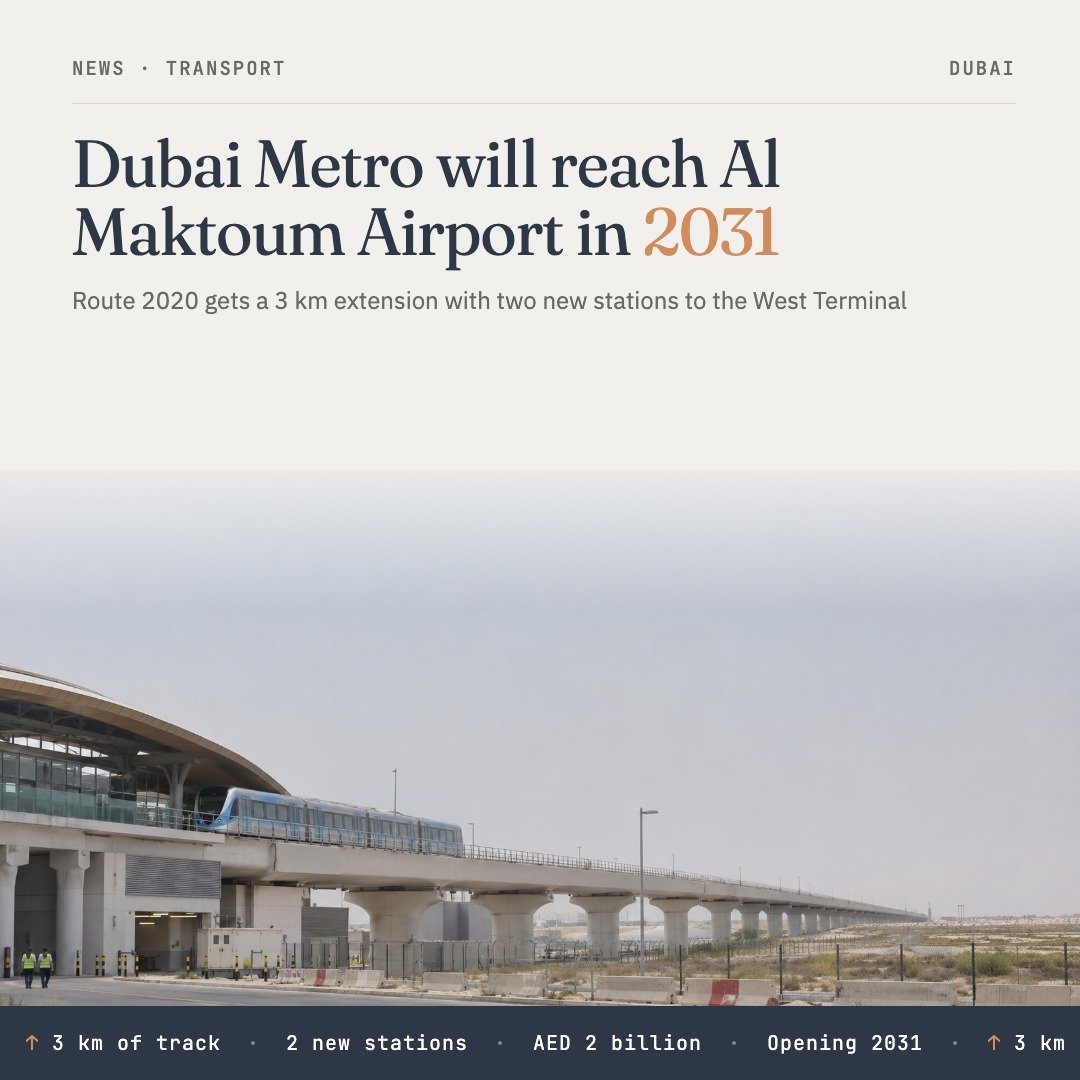
Dubai has approved a package of strategic projects worth more than AED 11 billion. One item in it reshapes the southern part of the city: an extension of Dubai Metro's Route 2020 to Al Maktoum International Airport City. Services on the new section are scheduled to start in 2031. The extension costs AED 2 billion and adds a 3 km stretch to the existing Route 2020 network. For buyers who think in terms of where daily life will move over the next decade, the announcement is a concrete data point.
What has been approved
The extension adds two new stations and links the line to the West Terminal of Al Maktoum International Airport. The Roads and Transport Authority (RTA) and the Dubai Engineering Projects Establishment will deliver it together. That matters for buyers because a project with a named budget, named delivery bodies and a service date is a different asset class of information from a master plan sketch. A budget and a date can be tracked against progress. A vague ambition cannot.
The existing Route 2020 line gives a sense of what the new section joins. It runs 15 km on the Red Line, with 11.8 km elevated and 3.2 km underground, and has seven stations between Jebel Ali Metro Station and the Expo 2020 Station. The new 3 km piece is short next to that. Its importance comes from where it ends. A short link that reaches a major airport terminal changes who can reach the area without a car.
Why a short extension carries weight
Rail distance and economic distance rarely match. Three kilometres of track can move a district from "a long drive away" to "one line from the rest of the city". Residents, airport staff and visitors gain a predictable commute that does not depend on road traffic. Employers gain a larger hiring pool. Landlords gain a tenant group that can live farther from the workplace without paying for it in time.
Our team looks at transit announcements through this lens. The question we ask is who gains a new option once the stations open, and whether those people are likely to rent or buy nearby. In the southern corridor the answer is wide. Airport employees, logistics workers, engineers and the families around them all make up the potential demand base.
How earlier lines show the pattern
Dubai already has two useful reference points. The first is Route 2020 itself, built to connect Jebel Ali with the Expo 2020 site. The second is the Blue Line, which is still under construction.
The Blue Line is 30 km long with 14 stations and is set to begin operations in September 2029. Its contract went to a consortium of MAPA, LIMAK and CRRC. It is expected to serve nearly 200,000 passengers daily by 2030, rising to 320,000 daily by 2040, and it includes the metro's first crossing over Dubai Creek via a 1,300-meter bridge. Those figures show how seriously the city treats rail as the backbone of growth. A line sized for hundreds of thousands of daily riders is a statement about where the city expects people to live and work.
The DWC extension fits the same logic at a smaller scale. It is cheaper and shorter, and it ends at a hub that the wider aviation plan will make far busier. The market has a habit of pricing infrastructure in stages, first when a route is confirmed and again when service begins. Buyers who study those stages can tell which part of the cycle a given district is in.
Timing for different kinds of buyers
The 2031 date is far enough away to matter and near enough to plan around. We see three practical situations:
- An off-plan buyer entering a southern corridor project with handover before 2031 holds the unit through the period when the extension is built. Whether that period delivers anything depends on the developer's schedule, the payment plan and the quality of the location. The metro does not fix a weak project.
- A buyer seeking rental income should check how the unit sits relative to the planned stations and the main roads, and how many comparable units are expected to reach the market at the same time.
- A long-term holder focused on end use can treat the extension as a quality-of-life improvement that arrives after the purchase, with no need to time the market precisely.
In each case, the metro is one input. Payment terms, developer delivery record, service charges and the unit's layout decide the outcome at least as much as the transit line does.
A multimodal hub at the West Terminal
The new West Terminal station is engineered as a multimodal transit hub. It is designed to connect the Dubai Metro Red Line and the Route 2020 branch with the planned Airport Express Line between DXB and DWC, and with the Etihad Rail national passenger network. A station where three modes meet has a different profile from a single-line stop. It can serve airport passengers, regional rail travellers and city commuters from one point.
The extension also sits within the phased transfer of commercial aviation from Dubai International Airport to Al Maktoum International Airport under the Dubai 2040 Urban Master Plan. The AED 128 billion terminal investment approved in 2024 is designed for 260 million passengers a year. Dubai South is projected to grow into a city of 1 million residents around the airport. The metro link is one of the pieces that makes such a city workable.
Price context in the southern corridor
Ready one-bedroom apartments in Dubai South trade at an average of AED 730,000 to AED 740,000, with annual rents averaging AED 55,000 or more. Price per square foot sits roughly 60% below central prime districts such as Downtown Dubai. These figures describe a market that is cheaper at entry and that is already seeing rental growth of about 20% year on year. They also show why the area attracts buyers who want exposure to Dubai infrastructure without paying for a central address.
A cheaper entry price comes with trade-offs. The district is still being built out, amenities arrive in phases, and the benefits depend on the airport transfer actually happening on schedule. We advise buyers to treat the forecasts as scenarios to test, and to check the current price per square foot against recent transactions before committing.
Golden Visa arithmetic
The AED 2 million property threshold for a Golden Visa makes the price gap concrete. In a central district, that budget often buys a single compact apartment. In the southern corridor, the same budget can cover a larger home or several smaller units. Eligibility rules and the way a portfolio qualifies should be confirmed with the relevant authorities before purchase. Our team can walk through the documents involved.
What to check before buying
- The handover date of the project against the 2031 service date.
- Walking distance to the planned stations and the quality of the road links.
- The developer's delivery record on earlier phases.
- The number of competing units launching in the same area.
- Service charges, payment plan terms and the resale or rental assumptions behind the sales pitch.
Frequently asked questions
When will the Dubai Metro reach Al Maktoum International Airport?
Services on the Route 2020 extension to Al Maktoum airport are scheduled to commence in 2031. The extension adds 3 km of track and two new stations, ending at the airport's West Terminal.
How much does the extension cost and who builds it?
The extension costs AED 2 billion and belongs to a wider package of approved projects worth more than AED 11 billion. The RTA and the Dubai Engineering Projects Establishment will deliver it.
Does the metro extension guarantee higher property prices?
No guarantee exists. Transit links tend to improve access and tenant demand, but returns depend on the project, the price paid, the handover date and the rental market. Buyers should compare each unit against current transactions in the area.
How uae-prop helps
Our team helps buyers evaluate southern corridor projects against delivery schedules, payment plans and realistic rental assumptions. We work on the buyer's side of the table and can compare options across Dubai South and neighbouring districts. Reach out to uae-prop to discuss a shortlist.
Sources
- Gulf News, Dubai approves Dh11 billion projects including Dubai Metro extension to Al Maktoum Airport City by 2031
- Gulf News, Dubai Metro Expansion to Connect Al Maktoum Airport City by 2031
- The National, Dubai to launch Metro line to Al Maktoum Airport to boost connectivity
- Dubai Media Office, Hamdan bin Mohammed tours Route 2020 Project
- Dubai Media Office, RTA awards Dubai Metro Blue Line contract to Turkish and Chinese consortium
- Gulf News, Dubai Metro Blue Line to start operations on September 9, 2029