
Dubai's 3.5 Million Trees by 2040: What Buyers Should Check
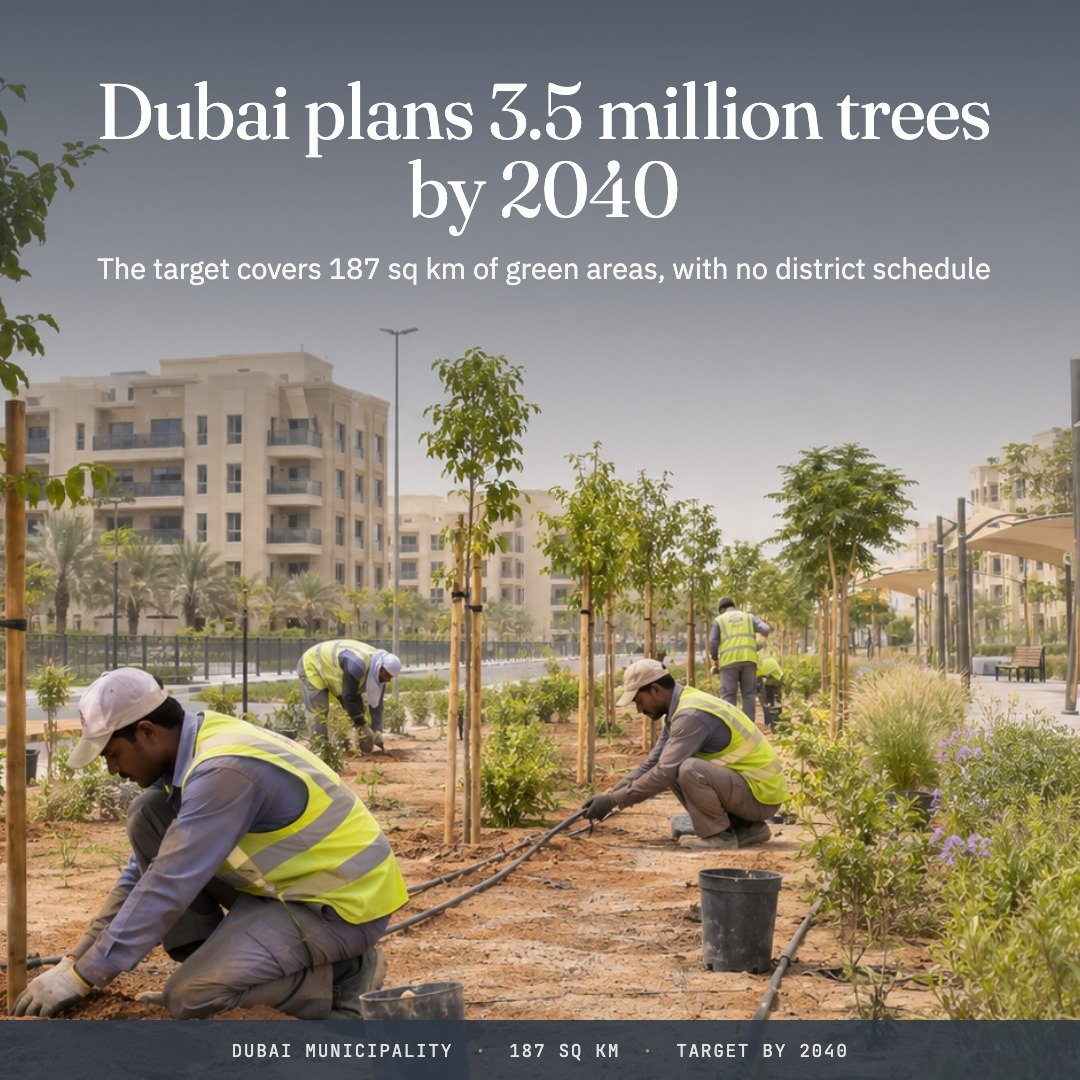
Dubai Municipality has put a number on the city's canopy for 2040. It plans approximately 3.5 million trees across 187 square kilometres of green and cultivated areas. The targets were presented by the municipality's Director General at the Mohammed bin Rashid Leadership Forum, in a session on quality of life. They are long-term planning goals. Nobody has promised that a given street, tower or villa cluster will get trees on a set date.
For a buyer, the useful question is what such a target changes in the way we compare neighbourhoods and projects. Our team looks at it from that angle below.
The numbers behind the announcement
Four figures define the plan. Approximately 3.5 million trees by 2040. 187 square kilometres of green and cultivated land. A per-capita target of 11 square metres of green space. And 95 million annual visits to parks and recreational facilities as a further ambition.
All four are targets. None of them describes today's measured outcome, and none comes with a published delivery schedule by district. We treat them as a statement of direction. The city is saying that public green space will carry more weight in how Dubai is planned.
The wider planning frame
The tree count sits inside the Dubai 2040 Urban Master Plan. That document calls for doubling green and recreational spaces and for green corridors linking residential areas, services and workplaces. It also aims to widen opportunities for walking, cycling and sustainable mobility. The government's summary of the plan states that nature reserves and rural natural areas are intended to make up 60% of the emirate's area.
The corridor idea matters most for property decisions. A tree count tells you how much is planted. A corridor tells you whether a resident can actually walk from the front door to a shaded path, a park and a workplace. A neighbourhood with fewer trees and a continuous route can feel more livable than one with many trees behind a motorway.
The nearer-term roadmap
Dubai also runs a separate Blue and Green Spaces Roadmap 2030. Dubai Municipality says it targets about 1.5 million trees over five years, more than 45 landscaping and beautification projects, and 120 new parks covering nearly 3 million square metres. The roadmap is presented as aligned with the 2040 master plan.
One caution on arithmetic. The 1.5 million and the 3.5 million should not be added together. The published sources do not say whether the figures overlap or how trees are counted in each. Anyone quoting a combined total of 5 million is inventing a number.
The 2030 roadmap is still the more practical document for a buyer with a five-year horizon. Its mix of parks, landscaping projects and planting shows that the public realm is being built as a set of projects, with tree planting as one part of it.
What developers are doing in parallel
Private developers have picked up the same theme. Ghaf Woods, a Majid Al Futtaim residential community, is planned around a forest-style landscape. The landscape architect's project description cites more than 7,000 homes and over 35,000 trees, with phased completion through 2031.
The scheme shows how greenery is now packaged as part of community identity. It is also a developer's design commitment, which is a different category from a municipal target. The two should be read separately. One project's landscape plan says nothing about how other green-themed projects will perform, and it carries no evidence on rents or resale prices.
The buyer-side checklist
Our advisory team suggests four questions before any green claim enters a purchase decision.
Is the greenery inside the development or on public land
A park on the developer's plot is covered by the master plan and the handover scope. A park on public land depends on a municipal project with its own timeline. The brochure often shows both in the same render, and the documents treat them very differently.
Is it built, approved or conceptual
Ask for the approved landscape drawings and the handover scope. A planned corridor drawn on a concept map is an intention. An approved and funded route is a commitment. Label them accordingly in your own notes.
Who maintains it, and who pays
Trees need irrigation, pruning and replacement. Request the service charge breakdown and find out which line items cover landscaping. A lush common area with an underfunded maintenance budget looks very different after three summers.
How do you actually reach it
Check the walking distance from the unit to the nearest existing or approved green space, and whether the route crosses a major road. Access is easy to verify on site and rarely appears in a sales presentation.
What it means for different buyers
For off-plan buyers, the announcement is a prompt to examine location and infrastructure more carefully. It does not guarantee a view, a park next door or a higher resale value. The documents listed above are where the real answer sits.
For Golden Visa holders, the story speaks to liveability and long-term urban planning, particularly for families weighing outdoor recreation, walkability and community amenities. It has no effect on visa eligibility and does not mean that a specific property qualifies. Current visa rules and property conditions should be confirmed through official channels.
For Dubai investors, the plan reinforces a comparison habit we already encourage: rank neighbourhoods by public-realm quality and connectivity, and treat headline amenities as one input among several.
Investors looking at Abu Dhabi or Ras Al Khaimah can use Dubai's announcement as a benchmark for how green infrastructure is positioned in marketing and planning. Each emirate has its own plans and delivery record, so each needs independent assessment. Dubai's targets do not apply elsewhere.
What we would not claim
Greenery is often sold with promises attached: cooler streets, higher prices, rental premiums, stronger returns. The sources behind this announcement support none of them. Any such claim needs project-specific evidence, such as measured temperature data, comparable transactions or rental records from the same community. Until a project can show that evidence, we treat greenery as a lifestyle and planning factor with value that is hard to price.
How our team approaches it
The uae-prop team works as an independent buyer-side advisory desk. When a client asks about a green-themed project, we pull the master plan, the approved landscape scope and the service charge schedule, and we compare them with what the marketing material shows. If you are weighing a project or a neighbourhood in Dubai, Abu Dhabi or Ras Al Khaimah, our team can help you evaluate those documents before you commit.
FAQ
Q: Will every Dubai neighbourhood get new trees under the 2040 plan? A: The announced targets are citywide. No source we reviewed gives a district-by-district planting schedule, so the plan cannot be read as a promise for any single street or property.
Q: Do the 3.5 million trees and the 1.5 million trees in the 2030 roadmap add up to 5 million? A: No. The sources do not explain whether the two figures overlap or how trees are counted in each. We use them as separate targets with separate time horizons.
Q: Does a green-themed development, such as a forest-style community, guarantee higher rents or resale prices? A: No. Developer landscape plans, such as the 35,000 trees cited for Ghaf Woods with completion through 2031, describe design intent. Price and rent outcomes need project-specific evidence from comparable transactions and rental data.