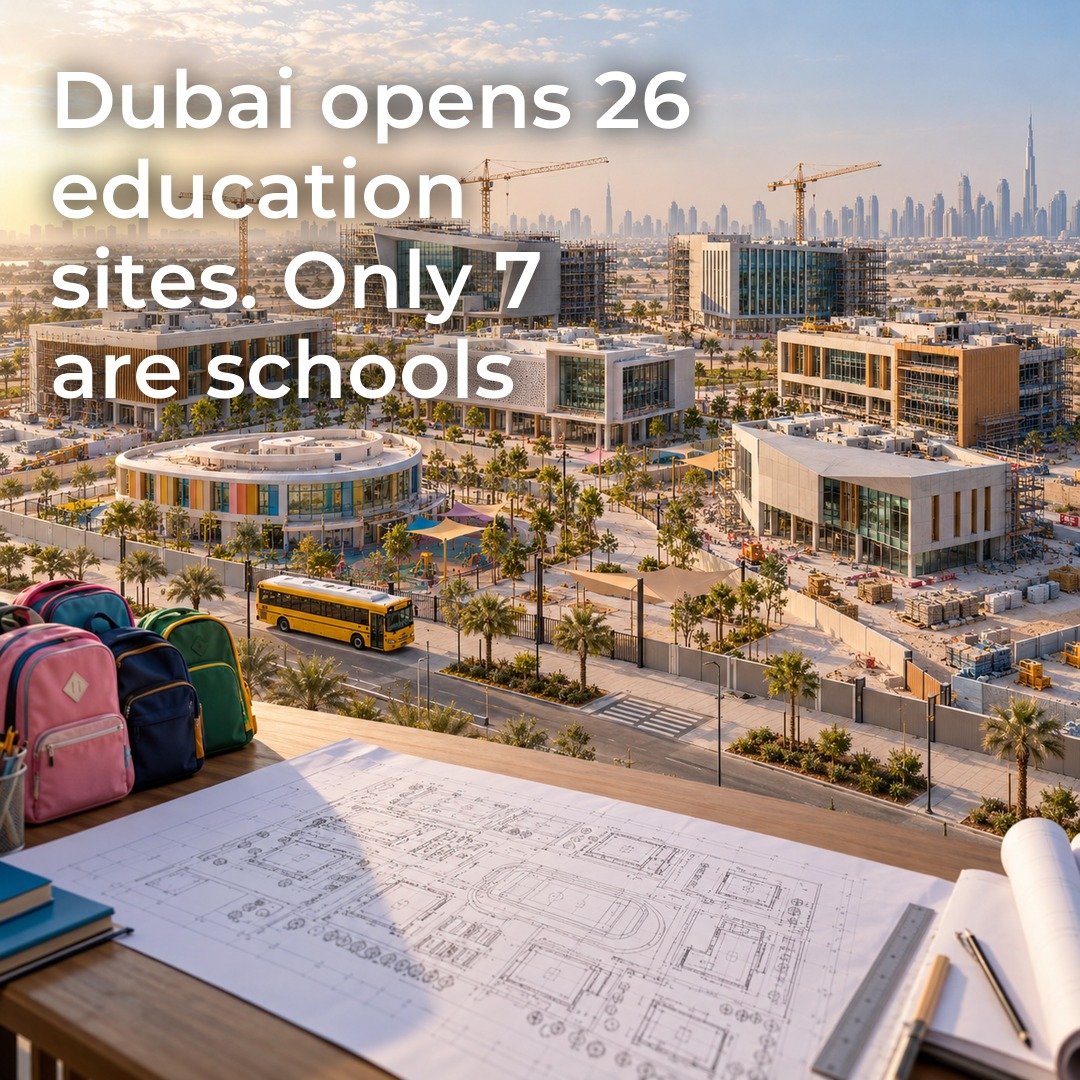

Dubai opens 26 new private education institutions in the 2026-27 academic year. KHDA has also said that around 18,000 affordable seats are expected to be added over the next two academic years. The two figures sit side by side in headlines, yet they describe different things, and the difference matters to anyone choosing a neighbourhood for a family.
What the 26 actually are
The official announcement from the Dubai Government Media Office splits the 26 into three groups. Seventeen are early childhood centres, seven are schools, and two are international higher-education institutions. Calling all 26 "new schools" overstates the picture by a factor of almost four.
The seven schools carry most of the capacity. Together they add 16,846 places. The 17 early childhood centres add a little over 1,700 more. The named schools include Harrow International School Dubai, Queen Elizabeth's School Dubai Sports City and Rugby School Dubai. Four of the seven offer a UK curriculum and three offer the International Baccalaureate. Established British brands and IB provision dominate the list, which tells families something about the segment this wave of openings serves.
The announcement does not publish a location and capacity for every campus. For that reason we avoid attaching any named school to a specific neighbourhood unless the buyer has checked it directly with the school or the regulator.
The 18,000 seats are a separate, forward-looking number
KHDA's later update puts the expected addition at around 18,000 affordable seats over the next two academic years. This is a target. It does not describe seats that have already opened, and it should not be read as the sum of the seven schools above. The 16,846 places in the new schools belong to the 2026-27 intake, while the 18,000 figure covers a two-year window across Dubai's private education sector as a whole.
The word "affordable" also deserves attention. The published material does not define it. There is no fee band, no cap and no year-by-year allocation. A family budgeting for tuition cannot yet translate "affordable seats" into a monthly number, and we would not encourage buyers to plan around lower fees until a school publishes them.
Why the city is building
The demand side is visible in the enrolment data. Dubai's private-school enrolment stood at 406,563 at the start of the new academic year, up 4.6% from about 388,731 in June 2026. Over the preceding three years the emirate added 21 private schools, while enrolment in the sector grew 3.1% over that period. In plain terms, the student population has been growing faster than the school count, and the 2026-27 openings follow that pressure.
The expansion sits inside the wider Education 33 Strategy, which sets goals around wider access to high-quality education and strengthening Dubai's position as an education destination. For a resident or a prospective resident, that signals a government that treats schooling as infrastructure, in the same category as roads and metro lines.
Capacity and enrolment are different measures
A new place does not automatically mean a filled classroom, a shorter waiting list or a higher property price. Capacity describes what a school can hold. Enrolment describes who has actually joined. A school that opens in September with strong admissions in the lower year groups may take several years to fill upper grades, and popular year groups at established schools can stay full even as new campuses open elsewhere.
For buyers, this means the headline number matters less than the specific school, the specific year group and the specific admission calendar.
What this means for off-plan buyers
New school capacity is a useful family-livability signal. A community with a credible school nearby is easier to live in, and tenants with children tend to look for exactly that. Our analysis stops short of treating it as a guaranteed capital-growth catalyst. A school opening alone creates no price premium, and none of the published sources quantify a property effect.
Before attaching any premium to a home near a new campus, our team suggests checking six things.
Campus location and the real commute
The distance on a map and the drive at 7:30 on a school morning can differ by 20 minutes or more. Buyers should test the route at the relevant hour.
Opening timetable
Some campuses open in phases. A school listed as "opening" may offer only certain year groups in its first year.
Fees
Published fee schedules differ by year group, and the gap between an early years fee and a secondary fee can be large. A family with children at different ages should price the whole journey.
Curriculum
UK and IB tracks lead to different pathways. The curriculum should match where the family expects its children to study later.
Admission availability
A seat in the right year group, at the right moment, is the real product. Asking the admissions office directly gives a better answer than any announcement.
Transport
School bus coverage and parking at drop-off are practical details that rarely appear in a brochure and often decide daily quality of life.
What this means for long-term residents and Golden Visa holders
For families deciding whether to settle in Dubai, education choice sits alongside healthcare, transport and housing. A wider range of schools widens the options, and the planned affordable seats may ease the pressure on mid-range budgets. The sources give no basis for promising lower fees or immediate availability, so we treat the plan as a direction of travel and keep decisions tied to what a school can confirm today.
Dubai versus the other emirates
This announcement is specific to Dubai. It does not demonstrate equivalent capacity, fee trends or property effects in Abu Dhabi or Ras Al Khaimah. Investors comparing emirates need education and housing data for each one separately, because school supply, fee levels and demand differ across them.
A practical way to use the news
We treat school proximity as one line in a due-diligence checklist, next to commute, transport links, service charges and the developer's delivery record. The 2026-27 expansion makes that line easier to fill in for some communities and still leaves it blank for others. Our team helps buyers evaluate a community from the viewpoint of the household that will live there, which starts with the school run and ends with the lease or resale conversation years later.
Frequently asked questions
Are all 26 new institutions schools? No. The 26 consist of 17 early childhood centres, seven schools and two international higher-education institutions. The seven schools add 16,846 places, and the early childhood centres add more than 1,700.
Have the 18,000 affordable seats already opened? No. KHDA describes around 18,000 affordable seats as an expectation over the next two academic years. The sources do not define "affordable" or publish a fee band, so families should confirm fees with each school directly.
Will a new school raise property prices nearby? The published sources do not quantify any price effect. A new school can improve the practical appeal of a community for resident families, but buyers should verify location, fees, curriculum, admission availability and commute before paying a premium for proximity.