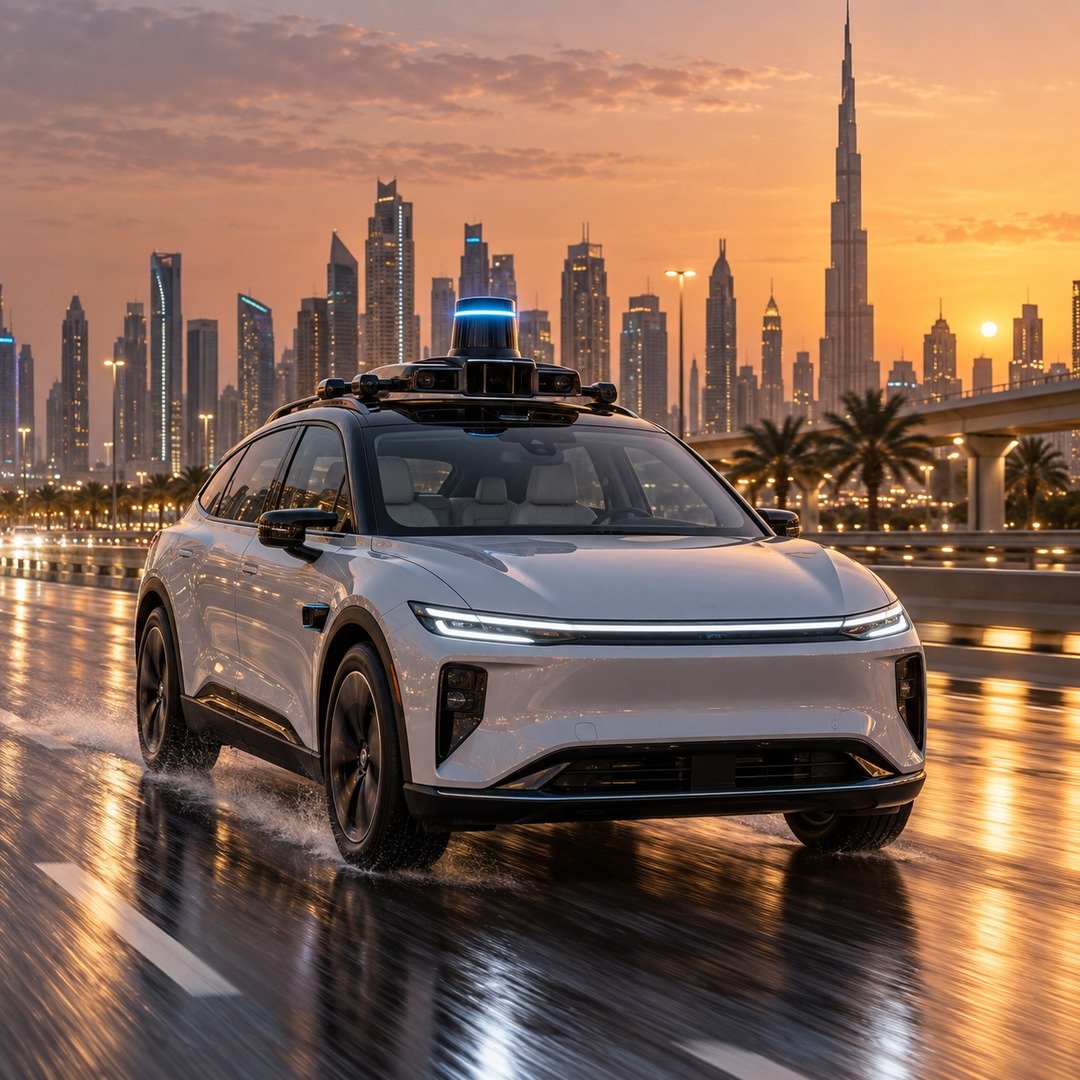

What Driverless Taxis and Paperless Government Offices Reveal About Dubai's Smart City Bet
A passenger climbs into a taxi in Abu Dhabi, opens a ride-hailing app, and watches the driver's seat sit empty for the whole trip. A few kilometers away, a resident renews a business license from a phone camera scan, without printing a single form. Neither moment makes headlines anymore. That is the actual measure of how far the UAE's smart city program has traveled: the strangest parts of it have already become routine.
The taxi that drives itself
Autonomous ride-hailing in the UAE did not arrive as a concept video or a press conference promise. It arrived as a working service that a resident can open on a phone in specific zones of Abu Dhabi, where trips run through commercial partnerships between local transport authorities and autonomous-driving operators. A safety monitor still rides along on many trips, and the routes are still limited to mapped zones rather than the whole city. But the core experience, a car navigating live traffic, reading signals, yielding to pedestrians, without a person steering, is no longer a demo. It is a booked ride.
Dubai has run its own parallel track. The Roads and Transport Authority has tested self-driving vehicles on real streets and stated an ambition to shift a meaningful share of everyday trips onto autonomous transport within this decade, spanning taxis, buses, and metro extensions designed with driverless operation in mind from the start. The emirate has also opened its skies to the idea, backing air-taxi trials as an extension of the same logic: move people without asking a human to hold the controls.
What is worth noticing is not the technology itself, since driverless cars exist in test fleets in several countries. It is the willingness to put ordinary paying passengers inside them on public roads, ahead of full nationwide rollout, rather than confining the experiment to a closed track. That choice says something about appetite for visible risk in exchange for being first.
The government office that fits in a pocket
The second half of the story is less cinematic but arguably reaches more people. The UAE government has spent years compressing bureaucratic tasks, license renewals, visa applications, vehicle registration, into a phone interaction that takes minutes. Facial recognition gates at airports let travelers walk through passport control without handing over a document. A single digital identity credential now unlocks dozens of government and private services that once required a physical visit and a stack of paperwork.
Dubai's government has said, by its own account, that internal paper processes have been eliminated from its public services entirely, a claim that would have sounded implausible a decade ago from an administration built on stamped folders and in-person queues. Layered on top of that digital base, AI tools now handle a growing share of routine government interactions, answering resident queries, flagging document errors before submission, and routing requests without a human clerk reading every file. The UAE was also the first country to appoint a government minister with AI explicitly in the job title, a symbolic move that turned into a standing policy structure rather than a one-off gesture.
One instinct, two experiments
Robotaxis and paperless government offices look like unrelated projects, one about hardware and traffic, the other about software and forms. They share a single instinct: remove the human step that used to be assumed necessary, and see what happens. A driver was assumed necessary for decades. A counter clerk was assumed necessary for decades. Both assumptions are now being tested in public, with real users, rather than in a lab.
That pattern extends further than transport and paperwork. Smart City initiatives across the UAE touch utility billing, school enrollment, healthcare appointment booking, and even parts of the judicial system, where some routine filings now move through digital courts. The common thread is a bet that friction, not capability, was the real bottleneck. Once a task can be described as a clear set of steps, the city seems willing to test whether a machine or an algorithm can run those steps faster than a person.
What we're actually watching
The detail worth holding onto is not any single pilot program. It is the sequencing. Most cities announce a smart city vision and quietly shelve the harder pieces, the ones involving physical risk or legal liability, while shipping the safe software updates first. The UAE has done the opposite in more than one case, putting the physically riskier experiment, a car with no driver carrying a paying stranger, on public roads before every regulatory question was fully settled elsewhere in the world.
Whether that sequencing becomes the template other cities eventually copy, or a cautionary case study, is still an open question. What is not in question is that the direction has already changed daily life for people who never think of themselves as living inside a pilot program. They just notice the queue is shorter, or that the seat next to them in the taxi is empty.
Frequently asked questions
Can the public actually book a driverless taxi in the UAE today, or is it still a closed trial? In parts of Abu Dhabi, yes. Residents and visitors can request an autonomous vehicle through a standard ride-hailing app in specific mapped zones. It is not yet available citywide, and many trips still carry a safety monitor onboard, but it functions as a real consumer service rather than an internal test.
Is riding in one of these vehicles considered safe right now? Regulators have approved the current trials for public roads, which involves defined operating zones, monitored routes, and in many cases a human safety presence onboard as a backup. It sits somewhere between a full commercial rollout and a closed test track, with oversight built in rather than removed.
What kinds of government tasks can actually be completed without visiting an office? A large share of routine transactions, license renewals, permit applications, vehicle-related paperwork, and identity verification can be completed through a smartphone using a unified digital identity credential. Many of these processes now run with AI assistance handling document checks and routing.
Does this mean government staff are being replaced by AI systems? Not entirely. AI tools are mainly deployed to handle repetitive, rules-based steps, document validation, routing requests, answering common questions, freeing staff for the parts of a case that need judgment. Complex or disputed matters still involve a person.
How does the UAE's approach compare with what other major cities are doing? Several global cities run autonomous vehicle pilots and digital government platforms as separate, often smaller-scale experiments. What distinguishes the UAE's approach is the speed at which pilots move from closed testing to public-facing use, and the coordination between transport authorities and digital government agencies pursuing the same underlying goal.
Where is this heading next? Public statements from transport and government bodies point toward wider geographic coverage for autonomous transport, deeper AI integration across public services, and expansion into related areas such as air mobility. The pace suggests the current pilots are treated as a starting point rather than a finished showcase.